Wednesday, July 20, 2016

Fieldwork fun: Eristalis tenax and pollinator diversity

The field season is on in earnest now. Yesterday I was surveying blooming plant species at my field site, taking photos of the blooming plants as informal vouchers for now (vouchers = samples to prove that I correctly ID'd the plant, often collected specimens deposited at an herbarium in my field), and I managed to snap this awesome shot:

Eristalis tenax on Achillea millefolium
This guy is rather interesting, and not just because close-up shots of insects are cool by default.

I am pretty sure this is Eristalis tenax (a.k.a drone fly), and positive that it is a syrphid fly (a.k.a. hoverflies or bee flies). Syrphid flies are a group of flies which are bee or wasp mimics, meaning that they have characteristics resembling those of bees or wasps, which in theory is an antipredator adaptation conferring the advantages of the mimicked species against particular predators. E. tenax, our awesome, rather big (13-15mm wingspan [1]) syrphid fly is native to Eurasia [1] and was introduced to North America [1] before 1874 [1]. It is now widespread in North America [1,2].

The larval stage of this species is rather unappealing (called a rat-tailed maggot) and can pose problems particularly at agricultural sites, where they can become overabundant in ponds and livestock areas [3]. There have been cases of accidental ingestion of the eggs/larvae and subsequent myiasis (infestation by flies) of humans, causing unpleasant illness etc., but apparently the myiasis is treatable [3].

E. tenax is a pollinator, as adults feed on nectar [3] and so can be pollen vectors. indeed, although we tend to think of bees when we talk about pollinators, there are many other types of pollinator: flies, syrphid flies, butterflies, moths, skippers, wasps, birds, bats... There is even one documented case (research article) I am aware of where a lizard was demonstrated to be a pollinator!

I went digging around in the literature about E. tenax and found a study which compared the efficiency (transfer of pollen per visit) and effectiveness (number of visits per unit time) of E. tenax (and several other non-managed species) at pollination of Brassica rapa var. chinensis (pak choi) [link to open-access article]. The researchers conclude that E. tenax is equally effective and efficient as A. mellifera (European honeybee, a managed pollinator of considerable economic importance which is used extensively globally as a crop pollinator) on an individual basis as a pollinator, but due to much lower numbers of individuals in the populations of this and other alternative pollinators, A. mellifera remained the most important effective pollinator.

Just for fun, here's another syrphid fly I've photographed before. I think it's Toxomerus marginatus, but I'm not positive on the I.D. I am fairly sure it's at least in the genus Toxomerus, but I may be wrong about the species.

Toxomerus marginatus (?) on Rudbeckia hirta

Saturday, July 16, 2016

What's that structure: Iris versicolor and derived floral anatomy

I was reminded today (by facebook) that three years ago Iris versicolor was blooming when I was visiting a friend's cottage and that I had taken a number of very nice photos and shared them. Seeing these photos brought to mind the particularly interesting anatomy of this flower, so I felt inspired to write a post about it today.

Iris versicolor on the bank of a river
I have posted about this flower, and shared these particular photos on this blog before, but back when this blog was quite a bit lighter on the science. I briefly talk about the unusual floral anatomy of Iris versicolor (blue flag iris, fr: clajeux), but I did not go into much detail, nor did I put the information into any context about floral anatomy generally.

Today's post is a sort of remedy to that previous post.

Let us begin with a basic understanding of floral anatomy. All flowers develop along the same fundamental plan, with assorted modifications. The more a flower deviates from the basic or foundational plan, the more 'derived' it is considered to be. Generally, more derived traits indicate greater evolutionary change over time relative the ancestral condition or trait.

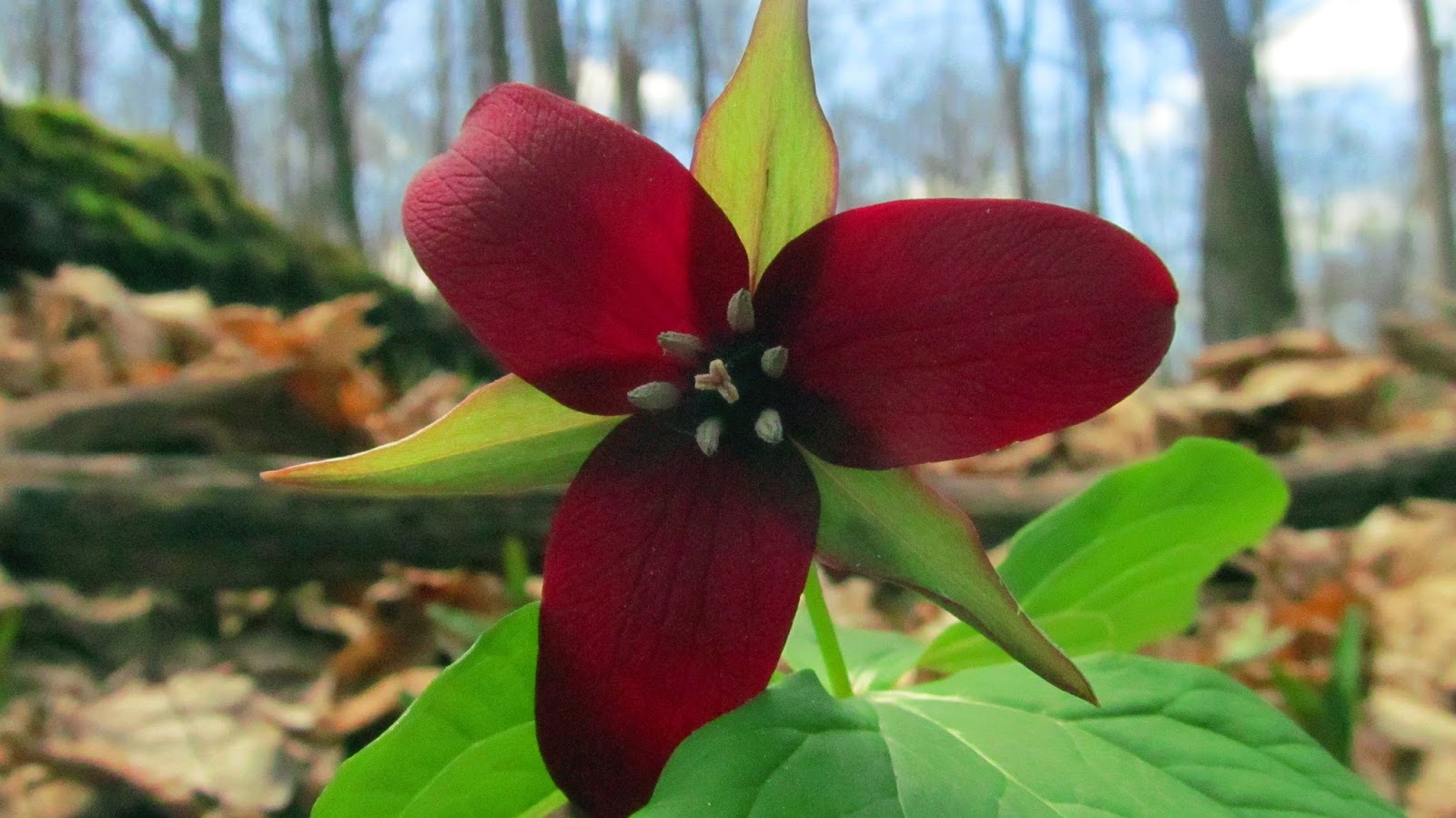
Trillium erectum (red trillium) - example of basic floral structure: the three green, pointed things on the outside are the sepals, the three red ones are the petals, then the six next ring are the stamens, and finally in the centre there is a visible stigma, which is attached to a style and ovary below. Note that these structures come in a specific order from bottom to top
It is simplest to conceptualize floral anatomy as divided into a set of ordered rings, from outermost to innermost; these will be easier to understand if you follow along with the photo of Trillium erectum above. These layers are derived from leaves (i.e. they are modified leaves, if we go back far enough in the evolutionary history of flowers). The outermost ring contains the sepals, which usually serve primarily as a layer to protect the developing flower in the bud stage, and sometimes also serving as structural support for petals. The next ring in contains the petals, which are of course the primary visual attractant structure. Assorted derivations of the basic petal plan can also help manipulate the orientation of a pollinator approaching a flower, thereby increasing precision of pollen transfer, or to restrict access of pollinators to various parts of the flower, thereby reducing resource loss to robbers or ineffective pollinators. In some families of flowers (notably, Lilaceae, the lily family, and Asparagaceae, the asparagus family), sepals serve similar attractive and structural functions to petals and are not immediately distinguishable from them visually. In these cases, we refer to both sepals and petals as tepals. Below, a photo of Lilium philadelphicum (wood lily) shows a great example of tepals. Notice the lack of any visible sepal, and also if you look closely where the tepals attach to the stem you can see that there are three attached lower and three attached higher; those attached lowers are derived from sepals and those attached higher are the 'original' petals.

Lilium philadelphicum, example of tepals
The next layers are the ones which produce reproductive cells: first, the stamens (composed of filament, a structural element, basically a stalk to, and anther, the portion of the plant that contains cells that create male gametes, i.e. pollen). This layer is responsible for the generation and presentation (exception: secondary pollen presentation in some families, a matter for another post entirely) of male reproductive cells. The innermost ring of cells is the female reproductive portion of the flower, containing some form of ovary with ovules inside, style(s) (a raised portion to receive pollen), and stigma(s), the receptive surface on this style which receives and germinates pollen for fertilization of the ovules. Together, a stigma-style-ovary set is called a pistil, and one flower may have many of these. The particular anatomy of this portion of a flower has a lot of variation I won't get into here, as the general notion presented here is sufficient for the purpose of understanding what's so cool about I. versicolor.

So, back to I. versicolor. Now that we have a reasonable understanding of floral anatomy, something seems odd about this flower.

Iris versicolor, top view
You may now be wondering -- where are the stamens, the pistils? I just spent a fair bit of time writing about all these rings of structures, but everything looks like a petal here.

The flowers of I. versicolor are highly derived; irises are of sufficient anatomical interest that there are actually special names for all the structures for these irises, but they are all analogous to the layers described above. I'll take you guys through these layers again from top to bottom and point them out with photos.

Iris versicolor
The outermost layer is supposed to be the sepals. This remains true in the irises. The outermost layer in this case, the sepals of this iris, are the three largest structures, the ones that broaden out in a kind of spoon-like fashion at the tips. The spoon-like portions are referred to as "falls" and the yellow patch as a "signal".

The petals are actually the three things sticking up in the middle, referred to as "standards" (somebody was way too enthusiastic about the quasi-military and flag-based metaphors in naming the parts of an iris).

Iris versicolor - style crest, falls, signal
This is where things get interesting now. We're still trying to find the stamens and pistils, right? They're found above the sepals; the pistils are that smooth-looking structure that curves down over the top of the sepals, while the anthers are curved and tucked underneath. The arching portion of this fused structure is called the style arm, and the raised portion at the very end that curls upward is called the style crest. Under the style arm, the stamens are arching along the top of the tube-like constriction made by the sepal and pistil. Finally, the stigma, the receptive part of the pistil, is a ridge of hard tissue at the intersection between the style arm and style crest, where the structure seems to 'fold' upward.

Iris versicolor - stigma, style crest, falls, signal
And that pretty much covers the awesome, highly derived anatomy of irises.

This particular species of iris, I. versicolor, is native to eastern North America (range map here). It is an obligate wetland species [1], found exclusively where there is sufficient water (lakesides, marshes, ponds, streams, etc). It is the provincial flower of Quebec.

Friday, July 15, 2016

Attack of the mutant thistle: homeotic genes and how a cell knows what organ to become

Over the weekend, I was looking around for some populations of Cirsium vulgare (bull thistle) for my research, and while wandering, I noticed a rather remarkable individual that displays several physiological abnormalities.

For context, here's a full-plant view of a reasonably normal (i.e., representative) individual, which was only about 2m away from our plant of interest.

Cirsium vulgare, structurally representative individual
It clearly has a central stalk from which numerous branches emerge, each topped with one to three (ish) flower buds. Most individuals were not yet actively blooming this weekend.

To understand what's going on here, some knowledge of plant development is required. This is not my area of expertise, so I apologize for any minor inaccuracies which may be found in the descriptions below.

When a plant is developing normally, the cells can be broadly split into two categories: differentiated cells, and meristematic cells. Meristematic cells are found in the areas of the plant experiencing active growth: root tips, stem tips, and flower buds. These cells have not yet become differentiated, that is to say that they are not yet assigned to a particular organ type (e.g. stem, leaf, petal, etc.). The areas where these cells are found are the places of active growth and development in a plant.

There are a regulatory genes which are responsible for determining which cells become which types of organs (they tell the meristematic cells what to become), which are broadly referred to as homeotic genes. The proper functioning of these genes is essential to the accurate physiological (anatomical) development of an organism. When homeotic genes are not functioning correctly, the consequence is usually a non-viable organism (i.e. an organism which cannot live). Sometimes, however, disruption of homeotic genes can be survivable. Generally, when something is seriously wrong with the physiology or anatomy of an organism, there's a good chance that a malfunctioning homeotic gene is responsible.

Homeotic genes are not exclusively found in kindom Plantae; indeed, quite a lot of research has been conducted on the function of homeotic genes in kingdom Animalia, especially with flies. There's quite a lot of interesting research about homeotic gene mutations or gene knockouts resulting in abnormal physiological development in many organisms, such as this study in mice which found that the silencing of one homeotic gene resulted in a continuation of anterior (front-body) anatomy development further along the body of mice -- basically, extra ribs.

A lot of studies have been conducted in this area for plants, as well, particularly using Arabidopsis thaliana, the world's most popular plant research organism. Manipulations of homeotic genes of this plant have isolated the particular genes responsible for the development of assorted organs in plants.

Now let's take a look at our unusual individual.

Whaaaaa-? Abnormal Cirsium vulgare

The most obvious oddity about this particular individual, from a distance, is the exceptionally thick stalk and lack of branching. It looks rather like a small tree from a distance (my husband mistook it for one at first).

If we get in closer, we can see that the stalk seems to be many fused stalks (note the vertical striations, and the strangely wide & flat shape). This is either because all the branching stalks have failed to separate from the trunk (possible), or because the apical meristem (developing portion of the vegetative part of the plant) is fasciated (misshapen, resulting in elongation along one plane). Hard to decide. I'm tempted to say fasciated, but the total lack of branching stems is throwing me off on that conclusion.


Close-up of the abnormal C. vulgare's central stalk; note the vertical striations and odd shape
The next weird thing about this particular individual only becomes obvious once one gets in a bit closer to take a look at the top of the plant, where we expect to see flower buds. Instead of normal C. vulgare flower buds, we see this:

Huh? Flower buds of abnormal C. vulgare

Cirsium vulgare flowers normally have a rather large receptacle (the lowest part of the flower, essentially a swelling of the stalk, which is often seen as a bulbous portion below the organs we more readily recognize as 'flower'), covered with spikes. In place of this spiky receptacle, this abnormal individual has an abundance of leaves. When cells which should have developed into one organ instead become another, we call this homeosis.

Finally, if you look closely at the flower bud in the lower right of the above picture, you can see that it is not classically round, instead looking strangely comma-shaped. This is called floral fasciation, where the floral apical meristem (portion of the plant actively developing into floral organs) becomes misshapen, so instead of round it gets stretched out like this.

You might be wondering at this point -- is this common? Well, no, such abnormalities are quite rare in natural populations, although it may be more accurate to say that such they are rarely found in living, viable individuals in natural populations (most of the time such abnormalities mean that the organism is nonviable and so never grows/develops, or dies extremely young).

You may also be wondering -- how did this happen? Well, that's a bigger question. I can't establish from observation of the plant, for example, whether the problem is that the homeotic genes themselves are altered (i.e. the genetic code is wrong; this is what we call "mutation"), or whether the homeotic genes are simply malfunctioning. The anatomical oddness of the individual could be the consequence of viral infection, fungal infection, parasitism, hormonal abnormalities, or genetic changes. Unfortunately, I don't have the tools necessary to determine how the mutant individual pictured above came about.

Given the sheer number of obvious abnormalities on this individual, I suspect that there is an external cause (i.e. that the mutations are induced), because this would be the simplest explanation. All the abnormalities being the product of a fungal, viral, or parasitic infection is a simpler scenario than the idea that each abnormality has a separate cause (which would be the case if this were a product of actual genetic changes). Of course, they may also be a product of a hormonal abnormality resulting from a single genetic mutation. I have no means of determining the cause, so unfortunately my speculation will remain speculation and I shall have to leave my curiosity unsatisfied on this score.

Of course, this individual will not be used in my research. It is entirely too non-representative. Despite being unsuitable for my work, at least it was an interesting specimen!

Saturday, June 4, 2016

Bluebead lily - Clintonia borealis - Poison à couleuvre

I have been at the lake for a few days, organizing myself for the upcoming field season and helping my parents set up the gardens. Today, I was working a bit less and so took the opportunity to take a walk and enjoy the weather.

I took quite a few photos, but the real surprise for me was discovering Claytonia borealis (common name: bluebead lily). While I'm familiar with the plant, this is the first time I've seen it blooming in person (probably because it blooms right in the middle of the bug season and I usually make it my business to have business elsewhere than the woods at this time of year). It's more familiar to me as a plant with metallic blue berries toward the end of July or the beginning of August.

Clintonia borealis whole view
This lovely little plant is at least 12 years old, as it takes at least a dozen years for an individual to establish itself sufficiently to bloom [1]. This plant was actually here alone, though this species is commonly colonial [2] , as it can reproduce through rhizomes (spreading root stalks) [1]. Once it flowers, it can either self-pollinate or outcross (receive pollen from other individuals) [1]. Because it is so slow to reproduce, this species is particularly vulnerable to disturbance such as excessive deer herbivory [1]. If you have this species on your property, please do not cut the flowers or disturb the plants, if at all possible; despite their small stature, flowering individuals are quite old and the next generation will only replace them very slowly.

C. borealis is found in boreal forests in eastern North America (range map here) and is exclusively found in wooded/shaded areas [1,3] . In the more southern parts of its range, it is restricted to mountainous areas with appropriately cool, shaded habitat. This lovely little plant is endangered in Indiana and Ohio, threatened in Maryland, and of special concern in Tennessee [4]. Unfortunately, the Plants of Canada database is currently down so I can't easily access information about its legal status up here. One Ontario source lists the plant as common, however, suggesting that at least in this province the plant isn't at any particular risk [5].

C. borealis is a member of the Lilaceae (lily family), and displays the 6-partite character of that family in the flowers, as shown in the picture below. The flower has 6 tepals (not petals, which only occur when there are also sepals).

C. borealis flower, close view
There appears to be some disagreement between sources about whether or not the berries are safe to eat. One source lists them as poisonous and posing a potentially fatal risk to children who cannot reliably distinguish between these berries and blueberries [5]. In my experience, C. borealis can grow in the shade of blueberry bushes and it does take some care to make sure to only collect blueberries when out foraging. That said, I've never accidentally consumed one of these and I was actively foraging for berries quite young. Another source, however, asserts that the berries are not toxic, merely extremely unpalatable [6]. I have always known it as a poisonous plant, but not through direct experience or any particularly definitive source. That said, I would recommend against ingestion of the fruit and that some care be taken to ensure that the berries aren't accidentally collected and consumed with blueberries.

I was only able to go out and truly enjoy the weather because the bugs were less severe today. We're just hitting the tail end of bug season; even yesterday, things were bad enough that my mother was frequently singing The Blackfly, sometimes cheerfully and sometimes more resignedly. Since it's a hilarious and delightful song, I've embedded the video below; the animation is a real treat, too, done by the National Film Board (of Canada). Enjoy!


Friday, April 1, 2016

The Spring Thaw Begins! Leptoglossus occidentalis, the western conifer seed bug

Earlier this week my labmate came in with a hitchhiker. Being as we are an ecology laboratory, we gathered 'round and identify our new lab pet (who has since been released outside again).

Leptoglossus occidentalis - I rather like this bug's funky patterns.
This individual is likely an adult just emerging from its overwinter hibernation, as the weather has been quite warm for the last few days and very rainy. It is missing one hind leg, unfortunately.

We've identified it as Leptoglossus occidentalis, the western conifer seed bug [1]. Despite the implication of its common name, this insect has actually been found as far East as Nova Scotia [2], though it has been suggested that this might represent a fairly recent range expansion. L. occidentalis has also been recently introduced to Europe, where it is considered invasive [2].

The common name is slightly misleading in that it implies that L. occidentalis eats the seeds of conifers. Actually, it eats the sap of conifers, collecting it at the base of developing cones; as a consequence of L. occidentalis sucking sap from the base of cones, the cones can end up being malformed or failing to develop (and thus end up with reduced seed production).

Since the weather is starting to turn and I have started to see flowers emerging on the trees and from the ground, the season has returned for me to blog a bit! I may not blog with the same frequency as last year, but I will make an effort to update regularly.

[1] Kaufman, Kenn, and Eaton, Eric R. 2006. Field Guide to Insects of North America. Hillstar Editions LC, Rocky Ridge.


Sunday, August 16, 2015

Wild Blackberry Preserves

I suppose you may be wondering why I haven't posted in a while. I have been a bit busy with a number of things.

On Friday we went out and collected blackberries (mostly Rubus allegheniensis, a small amount of Rubus flagellaris) and a few incidental handsful of raspberries (Rubus idaeus) and flowering raspberries (Rubus odoratus).

Our haul for the day
My brother also collected Laetiporus sulphureus (chicken of the woods), which he had seen emerge earlier this week and watching for ideal collection time. So that big orange thing is a delicious edible wild shelf mushroom.

Friday night, naturally, we feasted; we ate the Laetiporus sulphureus sauteed in butter and white wine, along with fresh corn (bought from the back of a farm truck, the freshest you can get without growing it yourself) and a bean salad made with the green and yellow wax beans from my father's garden. Then, of course, blackberries for desert.

But of course, that's about 12-13L in that photo, so quite a lot of blackberries. There were, therefore, enough for me to do what I really wanted: canning.

I decided to make wild blackberry jelly and wild blackberry jam. I took about 6.5L of the fruit and started by heating it up, and using a potato masher to squish the fruit:

Blackberries heating to extract juice
 Then I mashed the fruit in a sieve to extract the juice. I don't care if my jelly is cloudy/opaque, I just don't want the seeds in it.

Extracting the juice from the fruit
Extracted blackberry juice
Of course, the problem with making jelly is that you get this perfectly good seed and pulp mixture that is often discarded. I decided that I wouldn't do that; instead, I used it to make jam.

Leftover pulp & seeds
I got about 7 cups of juice from the extraction process. I cooked the juice with the sugar, lemon juice, and pectin:

Cooking the jelly
Then I put the stuff in the sterilized jars and canned it for the requisite 10 minutes in the hot water canner:

Homemade canning rack in hot water bath
Side note: I love this home canning rack. I have actually been puzzled for a long time about most canning racks, because most government (ie research-based) sources recommend that the top of jars in the hot water bath be covered by at least 1 inch of water, but the standard canning rack you can buy will be suspended too high (especially for 1/2L or 1L jars), where the top of the jar will actually extend above the rim of the canner. So I don't understand how these racks can be advertized for pickling, because they don't fit! So I got a cooling rack and asked my father to rig something up; the wooden stand underneath keeps the jars about 2" above the bottom of the pot (reasonably elevated), and because it's a cooling rack, I can put whatever dimension of jar I like in there, rather than the wire frame canning racks which tend to only accommodate certain sizes of jars. There's plenty of clearance for me to cover the jars suitably. Long story short, I do not generally recommend hanging canning racks unless the only preserves you ever make are in 250mL jars or smaller. And even then, water will tend to boil out of the canner with enough headspace above the jar.

I then took the leftover pulp and revitalized it by replacing the removed juice with fruit juice (I had pomegranate & blueberry on hand so that's what I used), then adding sugar, lemon, and pectin. I cooked the lot as with the jelly, and canned the same way.

The result? 19 jars of wild blackberry jelly, and 17 jars of wild blackberry jam (36 jars total) with a large quantity of leftover jam that I turned into fridge jam which has, hilariously, mostly disappeared already even though it has only been ready for about 12 hours. It would appear that it is popular.

A few of my jars of jam and jelly
My recipes are pretty simple. I won't bother noting the sterilization and sanitation procedures here, if you use this recipe make sure to follow proper canning safety for your elevation etc. Ingredients-wise:

Wild Blackberry Jelly

-7 c. wild blackberry juice
-12 c. sugar
-2 c. lemon juice (NOTE: this is to taste -- add more lemon juice if your blackberry juice is sweeter; I like a good tart jelly, but if you like it sweeter you can also reduce the lemon or increase the sugar)
-3 pouches of pectin

Yield: 19 jars

Wild Blackberry Jam

-Leftover blackberry pulp from previous stage (approx 6 c.)
-10 c. sugar
-6 c. juice (dark fruit juice is good)
-3 c. lemon juice (as above, this is to taste)
-2 pouches of pectin

Yield: 21 jars (I ran out of jars, that's why I only have 17; total volume would've filled 21)

Thursday, August 6, 2015

The Root of Invasives: Burdock - Arctium lappa - Bardane

One visually arresting plant that you will be more likely to find in disturbed environments (eg parks, cities, agricultural areas, roadsides) is burdock. This plant is an introduced invasive plant originally native to Europe and Asia [1], and has been introduced, likely as a garden plant.

Arctium lappa whole plant view
Arctium lappa (greater burdock) is a particularly striking plant, rising to an impressive top height of 2.7m or even 3m [1,2]; its lower leaves can grow to enormous sizes, and its large purple flowerheads on tall stalks make the plant almost impossible to miss.

Arctium lappa inflorescence
A. lappa is broadly distributed in the US and Canada (US range map here, Canada range map here). Though introduced, it has no special status in the US [3], but is listed as a noxious weed in several provinces [4], including Alberta [5], British Columbia [6], and Manitoba [7]. This is likely because it can spread very aggressively in nitrogen-rich soils (eg agricultural areas) [1], because it can cause skin irritation and rash on contact [8], and the fine hairs on the seeds can be dangerous if inhaled [8], and because there is some evidence that the plant may be toxic to some mammals [9].

Arctium lappa inflorescence
This plant is very well known for its edible root. The root of A. lappa used to be fairly commonly consumed by humans from Europe to Asia but currently is only common in Asian cooking (especially Japanese) [1]. The root is edible, best harvested in the fall of the first year of growth (burdock is biennial) [1]. It is mild and crisp. The young leaves and shoots are also edible, generally cooked as a pot herb or in salads [1,10].

A. lappa is a frequent staple of traditional Chinese medicine [1], but there is currently insufficient evidence for its use to treat a broad assortment of ailments [11]. Its use is specifically contraindicated for diabetics and pregnant women [10].

Arctium lappa inflorescence covered with bees
A. lappa seems to be quite popular with Bombus spp (various bumblebee species), as it was actually a challenge to get photos of it without bees.