Saturday, April 19, 2014

Mosses - Bryophyta - Mousses

Le printemps s'en vient rapidement. J'ai hâte que la neige fonde et que la glace sur le lac disparaisse. J'ai vérifié l'épaisseur de la glace ce matin; environ 4 pousses (ceci varie énormément à ce temps de l'année). Ça a l'air qu'on va avoir des chandelles bientôt; je vais sortir en kayak quand c'est possible pour écouter à la musique des chandelles aux vagues.

Glace du lac avec formes qui deviendront chandelles; lake ice with shapes that will become chandelles
Je suis sortie me promener dans les bois dans mes bonnes bottes en caouchouc (le sol est encore à peu près à moitié couvert de neige) et j'ai pris un tas de photos des mousses. E m'a acheté un guide de champ pour les mousses que je voulais essayer d'utiliser maintenant que l'opportunité s'est présentée. Ci-dessous se trouvent quelques photos avec une tentative d'identification.

Spring is coming quickly now. I'm eager for the snow to melt and the ice to recede from the lake. I checked the ice thickness this morning; 4 inches (extremely variable at this time of year). Seems that there will be chandelles this year, so I'm looking forward to going out in my kayak to listen to the ice sing as it melts. The photo above shows the shapes that form in the ice; as it melts it forms these long upright tubes that clink together in the waves.

I went for a walk this morning in my big ol' rubber boots (the ground is still half-snowy) and took lots of moss photos. E bought me a mosses field guide that I figured I'd try out now that the chance came up. Below are some photos and my preliminary attempts at identification.
Red/rouge: Polytrichum pilipherum (bristly haircap moss); Green/vert: Funaria hygrometrica (bonfire moss)
P. pilipherum is a very tentative I.D.; the colour I'm observing here doesn't appear to be fully reflected by anything in the guide. L'identification de P. pilipherum est douteuse; la couleur n'est bien captée par aucune des mousses dans mon guide.

Platylomella lescurii (bordered brook moss)
Tomentypnum nitens (golden fen moss)
Platygyrium repens (oil spill moss)
Left/gauche: Brachythecium rutabulum (rough foxtail moss) ; Right/droite: Dicranella heteromalla (fine hair moss)

Tuesday, October 1, 2013

Genus Acer - Fall Colours

Went walking with E. along the Eardley Escarpment over the weekend. The fall colours are particularly spectacular this year and just getting started. The maples (genus Acer) tend to start changing colours first.

Surprisingly little poplar (genus Populus) on our walk, so none of the early yellows that they provide are shown here. Sorry about that. They're more common a bit further North than the Eardley Escarpment, which is basically the Southernmost tip of the boreal forest (and Canadian Shield).

Looking East along the Eardley Escarpment
There are some great walking trails in Gatineau Park, one of which meanders along the top of the escarpment, providing a number of opportunities to look out to the South.

Acer rubrum - red maple - just starting to turn
Acer saccharum - sugar maple - in peak colour
The maples set the hills ablaze, brilliant and transient against the smooth blue sky.

Tuesday, September 17, 2013

Bur-Reed - Sparganium erectum

Les fruits du Sparganium erectum sont extrèmement distinctes; la boule couverte de genre d'épines ne se prend pas facilement pour autre chose. Je suis tellement occupée les dernières semaines que je n'ai pas pu rien écrire ici. Mes excuses. La vie ne laisse pas toujours du temps de loisir. J'adore mon nouveau programme et je suis contente d'avoir aussi un bon emploi comme assistante de recherche.

La plante présentée ci-dessous pousse dans les marais et est génétiquement proche aux quenouilles. Les espèces variées du Sparganium sont communes dans la région; je peux en compter trois par mémoire.

Sparganium erectum - fruit
Bur-reed (Sparganium erectum) is an easily identified plant in late summer and early fall because of its extremely distinctive ball-of-spikes fruit (pictured above). This genus of plants is relatively common in the area; I can recall three species off the top of my head that grow in this area. It's the closest genetic relative of the cattail, if I understand correctly.

I haven't been able to blog in the last few weeks because I've been ridiculously busy. Life has been extremely hectic. The good news is that I'm loving my new program and I have a research assistantship that's helping to pay the bills and keep me and E both in school. I'm struggling a bit with a number of things, but I've managed somehow to keep my head above water.

At least I have a couple of super-cool field laboratories this week!

Friday, August 16, 2013

Ebony Jewelwing - Calopteryx Maculata - Demoiselle

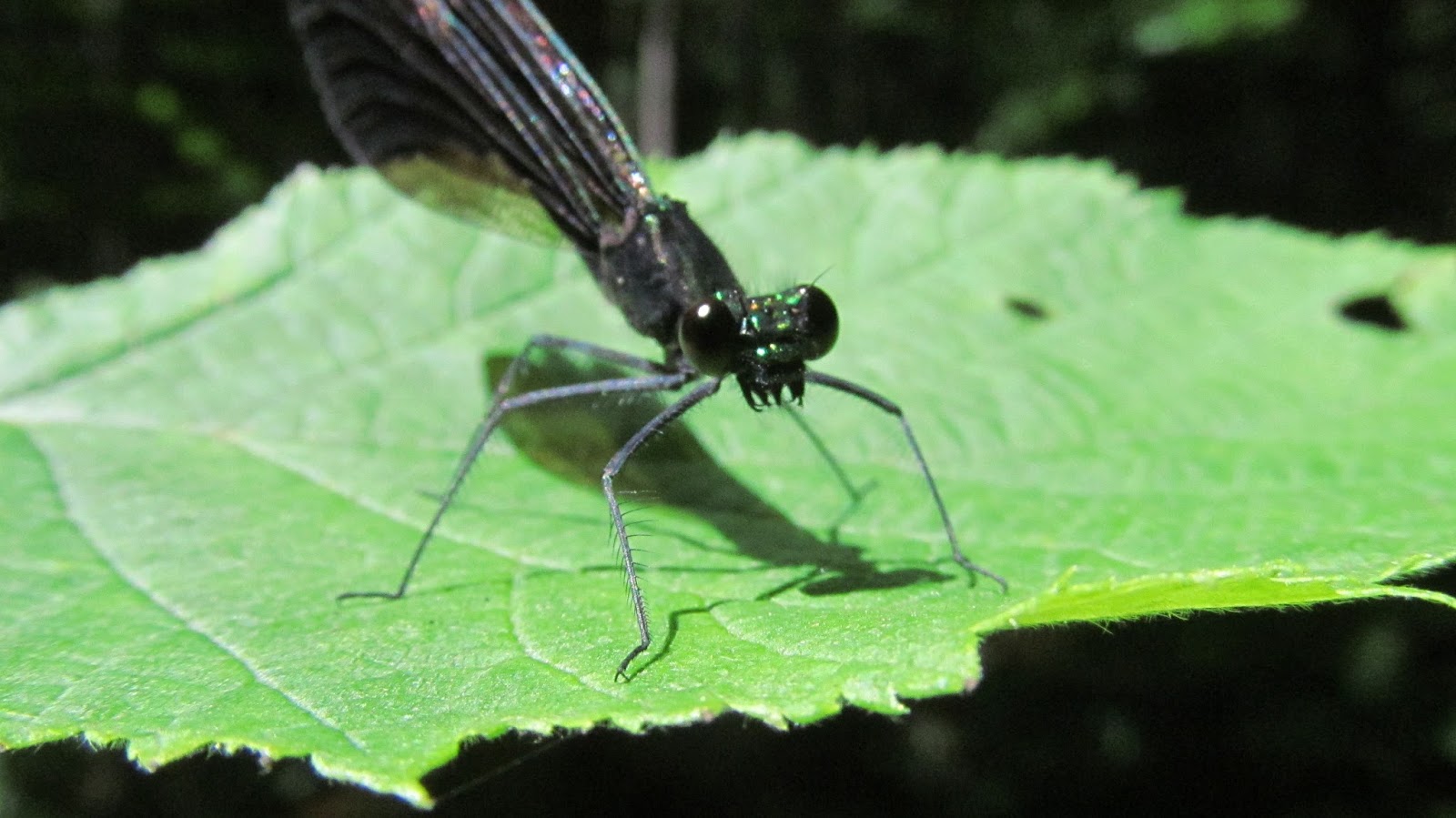
When we were climbing Mont Cayamant I saw a number of odonata I don't usually see at the lake where I am generally, which is interesting considering that they're within a bare 15km of each other. In any case, I spotted a female ebony jewelwing damselfly, Calopteryx maculata. She was fortunately not very shy at all and it was easy to photograph her quite extensively.

Female C. maculata
 This is a good shot that shows the creature pretty well, I think. I know it's a female because it has the white stigma (spot on the wing); males of this species don't have the white spot.

C. maculata face
 I like the fierce, toothy appearance of a damselfly face.

C. maculata eating its prey
In this photo you can see that she's eating a bug that she's caught. Cool-looking creature.

Thursday, August 15, 2013

Water Smartweed - Persicaria Amphibia - Renouée Amphibie

I'm finding that there are far fewer easy guides to aquatic plants in the region. I was very lucky to stumble on the identification of this plant. I present: water smartweed (fr: renouée amphibie), Persicaria amphibia.

P. amphibia inflorescence

I found this to be quite a lovely flower, with very long ovoid leaves. The flower stalk rose out of the water about eight to twelve inches and the pink flower stalks were each growing off a single branch of the plant.

Tuesday, August 13, 2013

Yarrow - Achillea Millefolium - Herbe à Dinde

A. millefolium inflorescence
Cette plante est très commune dans la région. Elle est facile à identifier et préparée comme thé était utilisée part les aborigineaux pour réduire la fièvre et pour aider à dormir. Je met cette plante dans mes tisanes, mais elle a un goût très fort donc je conseille les gens de l'utiliser de manière restraint. Avant d'y goûter, on devrait s'assurer qu'on n'a pas de réaction négative à cette plante, auquelle il y a parfois des allergies. Je suggère qu'on frotte la plante délicatement sur la peau et attende plusieurs heures; si la peau réagit, ne pas ingester la plante. Il faut toujours faire attention en ingestant des plantes sauvages et je n'encourage à personne de consommer des plantes sauvages sans s'assurer de n'avoir aucune allergie dangereuse et d'avoir aucun doûte de l'identification de la plante.

L'herbe à dinde est utilisée pour traiter de divers conditions et maladies. Un petit dix minutes avec Google montre que le monde crois à toutes sortes de bénéfices à cette herbe. Je vous encourage à évaluer les prétentions avec caution; beaucoups de ces prétentions ne sont aucunement prouvés et il faut exercer son jugement pour évaluer l'évidence. Nous savons que l'herbe à dinde contient de l'acide salicylique, qui peut réduire la fièvre et réduire la douleur. Il faut se souvenir qu'il est très difficile de contrôller la dose d'une substance qui se retrouve dans une plante sauvage et que ceci n'est pas un bon substitut pour des médicaments à dose controllée.

A. millefolium lateral view
Yarrow (also called: arrowroot, bloodwort, nosebleed, soldier's woundwort, & many other names)  is a very common plant in this region. It's easy to identify and as a tea was used by aboriginal people to reduce fever and help with sleep. I put this plant in my herbal teas, but it tastes quite strong so I suggest that people use it only moderately in tea unless you want your tea to taste like nothing else. It can cause allergic reactions so I would suggest that you rub some on your skin and check back in a few hours to see if you have a reaction before ingesting it. Also, the usual disclaimer about not ingesting wild plants if you have dangerous allergies and never to ingest a plant you don't have an absolute positive identification of.

There are a lot of claims all over the internet about the various (semi-miraculous, to hear some tell it) properties of yarrow. I would recommend that these claims be judged on their merits and on the weight of the evidence. We know that yarrow does contain salicylic acid, so the fever reduction and pain relief properties are likely to be true. All other claims need to be similarly evaluated on their merits. It's important to remember that even when we know that a plant contains a compound with known medicinal properties, the wild plant will always be a worse form than the pill because of issues controlling dosage; yarrow tea is not an improvement over acetaminophen, it's a step down because dosage is not known (less effective and less safe;  if you have the pill, don't substitute the herb).

A. millefolium bottom view
I'm taking time at the lake to try to recuperate. I'm working away at a number of things. Saw a deer with two young this morning. I'm snuggling my grumpy old Molly cat, who seems old now in a way she didn't last year. Still, I suppose she had to start acting like an old cat sometime and I guess if she starts in her 20th summer I shouldn't complain. I have a sense of permeating loss, the feeling of summer fading away into autumn... It's a strange feeling to experience combined with the excitement of changing my program and pursuing what I really want out of life.

Sunday, August 4, 2013

Black-Eyed Susan - Rudbeckia hirta - Rudbeckie

The black-eyed susan (this one is: Rudbeckia hirta) is a very common and recognizable flower, which many find very showy and attractive.

R. hirta inflorescence
Black-eyed susans are a very distinctive class of flower, easy to spot and identify.

R. hirtaserotina inflorescence lateral view
The conical shape is quite evident in a lateral view.

Black-eyed susans are a good cut flower.

Today, I'm planning.