Showing posts with label cayamant. Show all posts

Wednesday, August 5, 2015

Let the Feasting Begin: Blackberry - Rubus allegheniensis - Mûre

So for those wondering about the general dearth of posts from me in the last week or so, a quick recapitulation: I was working full-time while packing up to move. Then I was moving. Then I was getting settled and unpacked.

I have relocated from Montreal in preparation for beginning an MSc Biology (pollination ecology) in September. I am now residing in Ottawa, but for the month of August I will be staying at the lake in the Upper Gatineau (I challenge anyone, when given the choice to either hang out in Ottawa or at a lake, to choose differently).

I will still post about things found in Montreal, with photos already taken or new photos when I go to visit my husband, but for the month of August at least you can anticipate that my photos will be primarily from this region.

Such as the ones for today. One of the first things I did upon settling in was to evaluate the state of the various wild fruits in the area. A quick reconnaissance along the road to a few known blackberry areas yielded a few fruits just starting to turn. Blackberry season is starting, and they are absolutely magnificent this year.

Most of the plants around here are Rubus allegheniensis (alleghany blackberry, common blackberry), with a couple of Rubus flagellaris (Northern dewberry, Northern blackberry) thrown in here and there -- it looks a bit different in the leaves and fruit but the most obvious difference at least around here is its low growth habit (R. flagellaris seems to keep a very low profile, often below knee height, but long and creeping). R. allegheniensis is native to Ontario and Quebec, introduced to BC, and it has an unknown status in Newfoundland & Labrador [1]. It is native to much of the Eastern US and one Western US state [2] (US range map here, Canada range map here). The species is secure in all of its Canadian range [1], is unlisted in the US [2], and is globally a species of least concern [3].

Rubus allegheniensis flower
R. allegheniensis is a member of the Rosaceae (rose family), a group of plants I have mentioned quite a few times before. The flower above shows the distinctive 5-petaled flower common in this family. In fact, the cane berries, as well as a few others, are all members not just of this family but of the genus Rubus, which is a group of plants which produce aggregate fruit which are composed of drupelets. An aggregate fruit is a fruit which is formed by the fusion of multiple ovaries (as opposed to each ovary developing into a single fruit), and a drupelet is a small fruit with a 'stone' (a seed surrounded by a hard shell). So plants of the genus Rubus produce fruits that look like a collection of bubbles stuck together.

Rubus allegheniensis - aggregate fruit composed of drupelets
These fruit are absolutely delicious. They are certainly my favourite of the cane berries and they compete very hard with strawberries to be my favourite fruit.

Rubus allegheniensis - typical bush this year, absolutely laden with ripening fruit
They are coming into season now in the Upper Gatineau. I have many plans for them, which I may post about again in the next few days.

We went up Mont Cayamant yesterday, and I got a great shot of Lac Cayamant from the top which I think people may enjoy:

View of Lac Cayamant from the Mont Cayamant lookout tower
The weather has been very changeable in the last week. This shot really shows it; it is sunny, but there are many areas obviously shaded, and it's even raining on the right-hand side. A very mixed sky indeed. It was a lovely walk punctuated with delicious blackberries!

Friday, June 6, 2014

Eagle Rock - Montagne de l'aigle

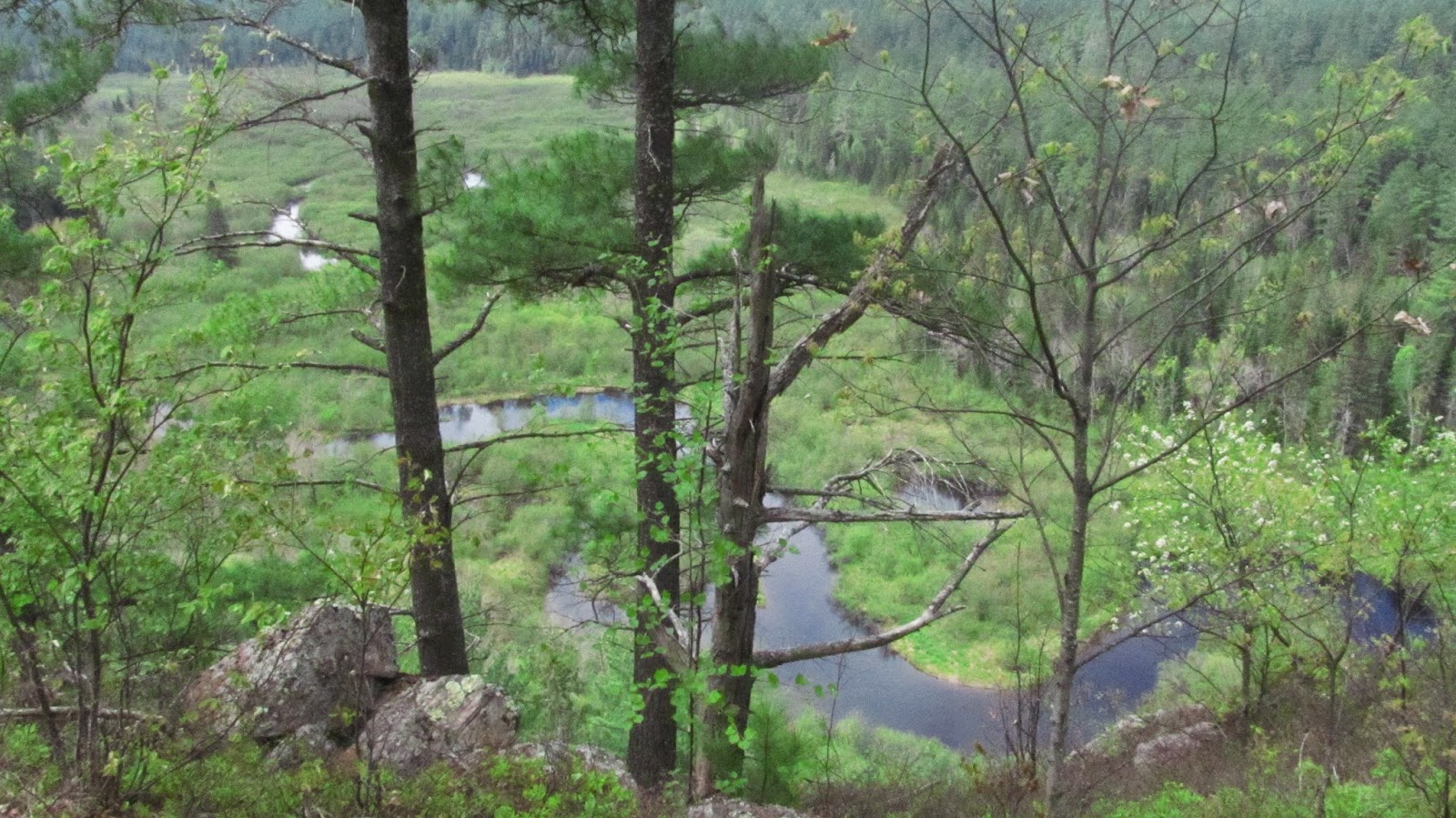
Near Cayamant, QC, there is an old lookout called la montagne de l'aigle (literally 'eagle mountain', usually called Eagle Rock in English).

The views from up there are quite pleasing, affording a fairly high vantage point to view the winding path of la rivière de l'aigle ('eagle river').

Here it is in early spring.

La rivière de l'aigle - vue du belvédère de la montagne de l'aigle

This picture shows very nicely that in this area, the river actually is more like a wetland with a passable section; it's all marshy scrub down there.

I may have gone off the path and up to the cliff a bit
These pictures are taken mid-May, just as the canopy is starting to close. The folliage wasn't yet full out but it wasn't more than a few days before it was. You can see that the choke cherries (bottom right) are blooming.

Le belvédère de la montagne de l'aigle offre une vue spectaculaire sur la rivière de l'aigle près de Cayamant. Le sentier ni le belvédère ne sont plus maintenus (la compangie qui faisait l'amménagement ne semble plus être en opération), donc je conseille que ceux qui y vont tiennent cette information en tête; ce n'est pas un endroit sans ses dangers (les fallaises sont les plus visibles des dangers dans une forêt non-aménagée, mais pas les seuls danger).