Showing posts with label pollinators. Show all posts

Tuesday, September 19, 2017

Impatiens capensis pollination (Bonus: even bees can be clumsy)

I know I haven't blogged in quite a while. Life got very hectic for a while. In the months my last post, I have finished my M.Sc., gotten published, and moved to the University of Toronto to start my Ph.D.!

Over the weekend I got a chance to take a long walk with my patient and long-suffering husband, who indulged my snagging his new blackberry to take a ton of footage of bees visiting the tens of thousands (at least!) of Impatiens capensis (common name jewel-weed) in the ravine park near our new home. I made all sorts of exciting videos, but today I'm going to share just a few simple ones, as the others will take quite a bit of research and time to write up. I will post these throughout the fall because they're very exciting.

NOTE: I have been informed that my videos don't work on mobile. I'm working on it, but in the meantime they do run on desktop.
UPDATE: try clicking the title of the video instead (treat as link) on mobile. Opens in youtube app. If you don't have youtube app, please report back telling me what it does when you click the video link!

To start, here's a picture of the plant itself:

Impatiens capensis whole plant view

Let's take a quick look at some general reproductive biology of I. capensis. The plant is monoecious, meaning that each plant reproduces through both male and female function; however, each individual flower is unisexual (i.e., any given flower is either male or female but not both). In the photo below, I show three flowers on the same individual. If you look at the top of the "mouth" of each of the lower two flowers in the picture, you will see that each has a different structure; the middle flower has a large, bulbous, whitish structure, while the rightmost flower has a slender green structure.

Impatiens capensis male (middle) and female (right) flower
The middle flower is a male flower; the whitish deposit on it is pollen, ready to be deposited on the back of a pollinator that climbs into the flower looking for nectar (the nectar is in the nectar spur, the little narrow tube curling off the back of the flower, visible on the middle flower). The rightmost flower is a female flower, with a stigma ready to pick up pollen from the back of a visiting insect.

The flower has some rather complex floral anatomy I won't get into right now. There's a pretty good explanation of which parts are sepals and which parts are petals here for those interested. The important thing to note is the lower lip, made of two structures wrapping around the front of the flower, one on each side, that form a sort of landing area of pollinators. They also restrict the width of the flower opening (see photos below).

Impatiens capensis male flower front view. Note that the two sides of the "landing" petals on the front are not fused, just overlapping, and that their shape, because they come down from above around the opening of the cone, reduces the size of the entrance into the flower

Impatiens capensis male flower side view. Notice that the lower "landing" petals are not attached to the conical structure behind.

So I'm going to skip over all sorts of exciting stuff about this plant (why does it have unisexual flowers? Why place pollen on a visitor's back? What's up with that super-complex floral shape?) in order to move straight to some awesome video of assorted Hymenopterans (bees, wasps, ants) visiting this awesome flower!

So I noted above that the '"landing" petals form not just a place for a pollinator to land on the flower, but also a constriction around the opening of the conical part; remember that the nectar is all the way at the back of that cone, in the little nectar spur curling down under the flower. There are several strategies to get past the opening to access this nectar (and then leave again after): one is to simply be small enough to fit through the constriction made by the landing petals; that's how Apis mellifera (honeybee) is doing it (note at 10:00 that you can really see the pollen on this honey bee's back!):


Backing out of the flower can be quite tricky. I managed to get some footage of a visiting wasp finding an alternate method of exiting, which capitalises on the fact that the landing platform and the conical structure behind are not attached to each other:


The Bombus sp. (bumblebee) workers I saw visiting the plants, however, were too big to fit through the opening. But, have no fear! They worked it out anyway. Here's one worker diligently visiting lots of flowers. She's making more room for herself by using her strong back legs (2 pairs) to push the landing petals apart a bit, so that she can shove her head and thorax into the flower and get at the nectar. You'll notice that she doesn't have much difficulty leaving, either, since she's well placed with four legs outside the flower. As far as I can tell, she's just dropping right out of the flower and then flying away.


Here's a longer video of the same bee, diligently visiting a lot of flowers in a row. There's also a little bonus at the end of this video. If you've been clumsy and felt ridiculous for it recently, I have something to comfort you: even bees can be clumsy. If you watch closely at the end, you'll see her climb into a flower, and then she and the flower both fall off the plant to the ground!

Thursday, May 29, 2014

Marsh Marigold - Caltha palustris - Populage des marais

During my time at QUBS, I did some (undergraduate, short-term, for a field course) research on Caltha palustris (marsh marigold, fr: populage des marais), family Ranunculaceae. It was a remarkably profuse bloomer and appears to be a pollinator generalist - it was pollinated by just about any insect which pollinates flowers, including bees (mostly Apis mellifera), bumble bees (Bombus spp.), solitary bees (diverse groups from Hymenoptera), syrphid flies (Syrphidae), true flies (Diptera), beetles (Coleoptera), and ants* (Formicidae). There were also some moths & butterflies around (Lepidoptera) but following our observation paradigm, my colleague and I witnessed no instances of these pollinators visiting the flowers - most likely just because they were so rare that it would have taken considerably more observer effort to see the Lepidopterans visiting C. palustris. There was no indication that birds pollinate C. palustris and I have no idea if bats visit the flowers (unlikely, as flowers which are specialized to attract insects tend not to have the various specializations which would attract birds or bats).

C. palustris
Solitary bee on C. palustris
C. palustris' conservation status is unranked but considering that it grows in wetlands (an increasingly threatened ecosystem), one should presumably treat the plant with caution. It certainly appeared in remarkable profusion at our study site, so we did not take extraordinary measures to safeguard it against our movement through the marsh etc, but I cannot speak for other sites. A good rule of thumb is to damage as little as possible regardless of the conservation status of an organism.

C. plaustris came rapidly into bloom at the test site and the flowers began to senesce within a few days. It is unclear whether the floral senescence was triggered by pollination (pollinators were remarkably abundant) or if the plant only ever sustains them for a few days.

C. palustris at the marsh - day 0 (project planning)

C. palustris at the marsh - day 1 (data collection)

Our study looked at the impact of floral outline (highly variable in this species) on pollinator behaviour. Tentatively, our results suggest that  the introduction of A. mellifera may end up altering the phenotype distribution in this population, as the A. mellifera showed a statistically significant preference for floral morph where the native pollinators do not. This has widespread implications for plant populations in North America -- however, we should take these results with a huge grain of salt because the data was collected by two undergrads in three days and the stats were an overnight affair.

Research photo used to quantify floral outline variation
As above
As above

I actually enjoyed sloshing about in the marsh, even when I was wet and muddy and losing my rubber boots to the mucky depths.Somehow, the tedium of watching bees land on flowers all day in the muck was quite agreeable to me.

*it is possible that the ants were not pollinating but rather stealing nectar, ie taking the pollinator reward without providing any pollen transfer for the flower; ants do pollinate some flowers but are mostly nectar-robbers. My colleague and I did not have a chance to establish with any certainty whether the ants were antagonists or mutualists with C. palustris.

C. palustris

Monday, July 8, 2013

Bumblebees - B. impatiens - Bourdons

So I suppose it's about time I talked about the garden a bit. This year, E and I are trying something new. Back in a post on July 5, 2012 (Pollination Station), I illustrated my method for ensuring pollination of some of the plants for which pollination is necessary for production. It involved running around with a brush, a decidedly inefficient and inelegant state of affairs. The garden I maintain is on three levels: ground level, second floor, and third floor. Pollinators are unfortunately quite rare on the third floor, presumably because bees well-laden with nectar and pollen don't have any interest in flying up two stories to look for more.

So this year we're trying something new. E is doing some bee research at a lab at the university, under the supervision of a researcher who has been invaluable in her assistance to get us started. Basically, we're raising a bumblebee colony. Bad. Ass.

... The process is surprisingly sensitive. We ran around with nets and pill bottles early in the season, capturing bumblebees (bombus impatiens), because early in the spring all the bumblebees are queens; the queen comes out of hibernation and flies around collecting pollen and nectar and looking for a suitable nest site, then eventually starts laying eggs. Actually, there's a rather low success rate for b. impatiens colonies, so it was necessary to capture multiple queens in hopes that one would reproduce, so I should say that only some of them eventually start laying eggs.

So. We caught some bees. Watched and waited. Finally, one of them appears to be incubating eggs. The rest have been released, and Gardenia (that's the name we gave the successful queen) has been moved outside and we've opened up the incubator for her in case she wants to forage. We've supplied her with nectar and pollen, as well as cotton to use in forming the initial nest, so she doesn't actually have to leave. Eventually her workers will leave the hive to forage. And then they will pollinate our garden goodies and I won't have to run around with a paintbrush anymore.

Peeking into the nest
 You'll notice right away while looking at the above shot that b. impatiens doesn't make the organized honeycomb that people generally expect when thinking of bees.

The incubator
 This is the exterior of the incubator. The closer portion is where the nest is; the further portion is where we're putting a capful of nectar for Gardenia, which prevents the need for her to venture outside in order to support the colony (the pollen we've provided her with is visible in the photo of the nest).

Location of the incubator
We've tucked the incubator into a quiet corner of the deck for now, with the exit facing directly into the planters where I've put some of the flowers I planted this year in order to supply the colony. We are anticipating the possibility that we'll have to provide them with nectar or pollen as the season wears on, but we'll be monitoring the colony closely.

We'll be moving the nest into its proper box soon so that the hive has the chance to grow and spread.

But of course, social bees aren't the only bees who pollinate the garden. Far from it; solitary bees (bees who do not form colonies, but rather forage & reproduce individually) are extremely common and also very important for pollination. Fortunately, keeping solitary bees is considerably less time-consuming and difficult than trying to establish a colony. Solitary bees just need to be provided with a suitable nest site, and they'll move right on in!

This is where my dad kicks ass. I was doing some research on solitary bees (I'm less familiar with them), and found out exactly how to set up for solitary bees. My father, once I explained the process to him, pulled out his drill bits and got some wood and helped me set up some solitary bee space.

I'm not really expecting to get any solitary bees this year (it's a little late for nesting), but at the very least we should get some next year. Since we have an apple tree in the back yard, that's to the good.

Close-up of part of the bee house
 Solitary bees are of varying sizes, so need tunnels of varying sizes to accommodate them. My dad drilled some holes of varying sizes on two sides of two of our fenceposts (total of four sides drilled). Solitary bees look for tunnels of the right size to nest in; holes in wood are appealing enough, so that's what we've put up here.

One of the bee houses from a distance
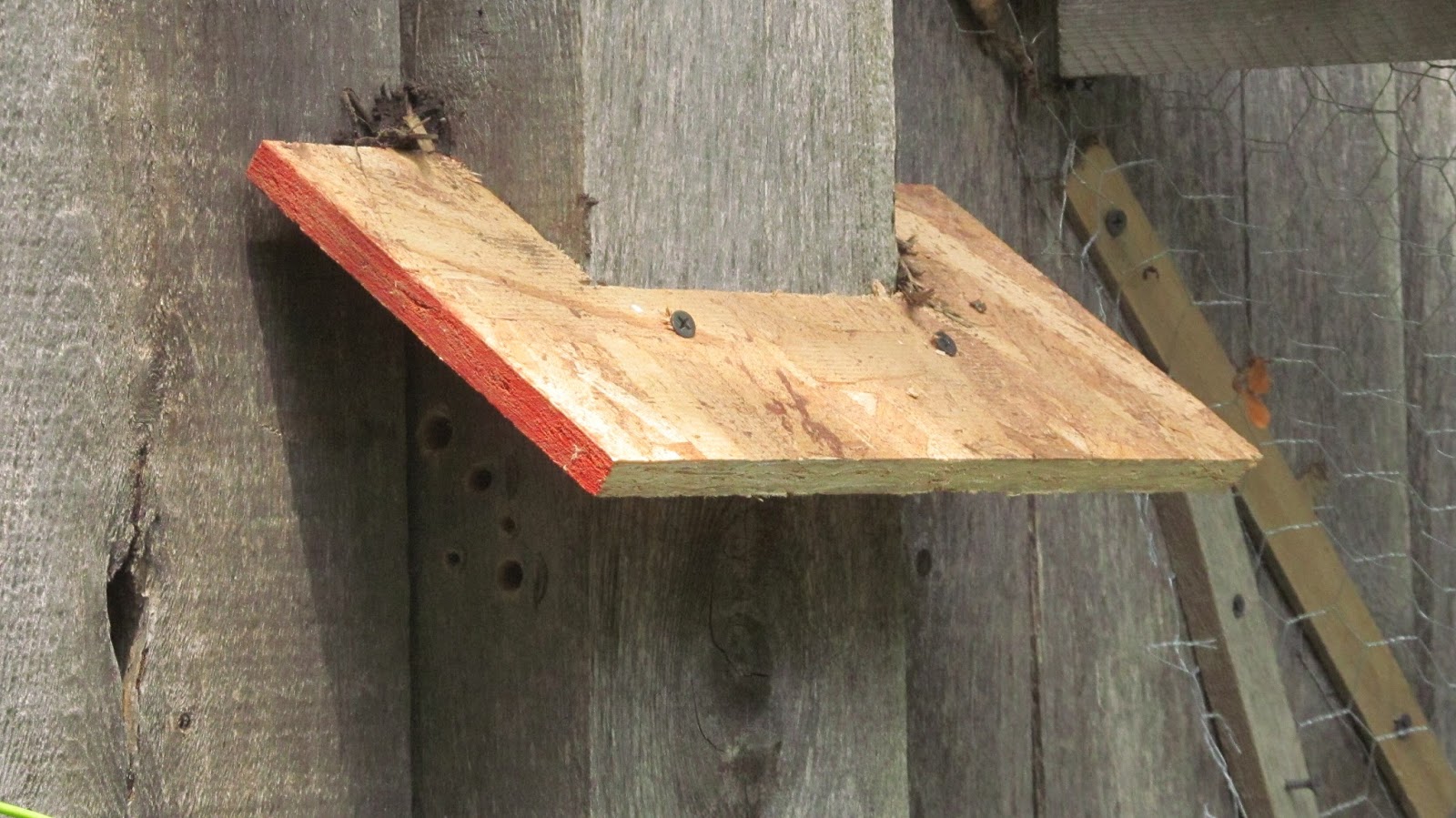
My dad then sheltered the bee houses, to keep the rain out (wetness prevents the bees from prospering).

So there we have it.  My dad rocks. So do bees.

Of course, this blog just wouldn't be what I've always envisioned it to be if I didn't take a moment to also share a photo of something I thought was particularly beautiful today. Enjoy.

Browallia speciosa

Calibrachoa