Showing posts with label spring ephemeral. Show all posts

Sunday, May 17, 2015

Early Meadow-Rue - Thalictrum dioicum - Pigamon dioique

Thalictrum dioicum (early meadow-rue) is native to North America (range map here), with a listed global conservation status of secure [1], unlisted in the US [2], and secure in Canada [3] except in Manitoba where its conservation status is unknown [3]. Note that, as with many of the USDA maps, the Canadian range is listed as more limited than the corresponding Plants of Canada database map.

This has happened a few times now with range maps I've looked at recently, so I'm going to take a moment to talk about my stance on disagreements between USDA listings and Plants of Canada database listings. For Canadian range information I will put my faith in the Canadian government source. So if you're in Manitoba with T. dioicum in front of you, scratching your head wondering if you're looking at evidence of the introduction or spread of T. dioicum based on that USDA map-- I doubt it, since the Canadian listing includes Manitoba in the native range of the plant. Ideally I would only draw the data from one source, but the Plants of Canada database maps don't show any information about US distribution at all. Since plants don't care about human borders, it is still informative to determine the rest of the range of the plant. So, two sources it is. In all cases where the two sources disagree about the Canadian range of a plant, I will assume that the data from the Canadian government is more accurate. I won't mention this again in my blog posts.

Thalictrum dioicum in bloom (male)
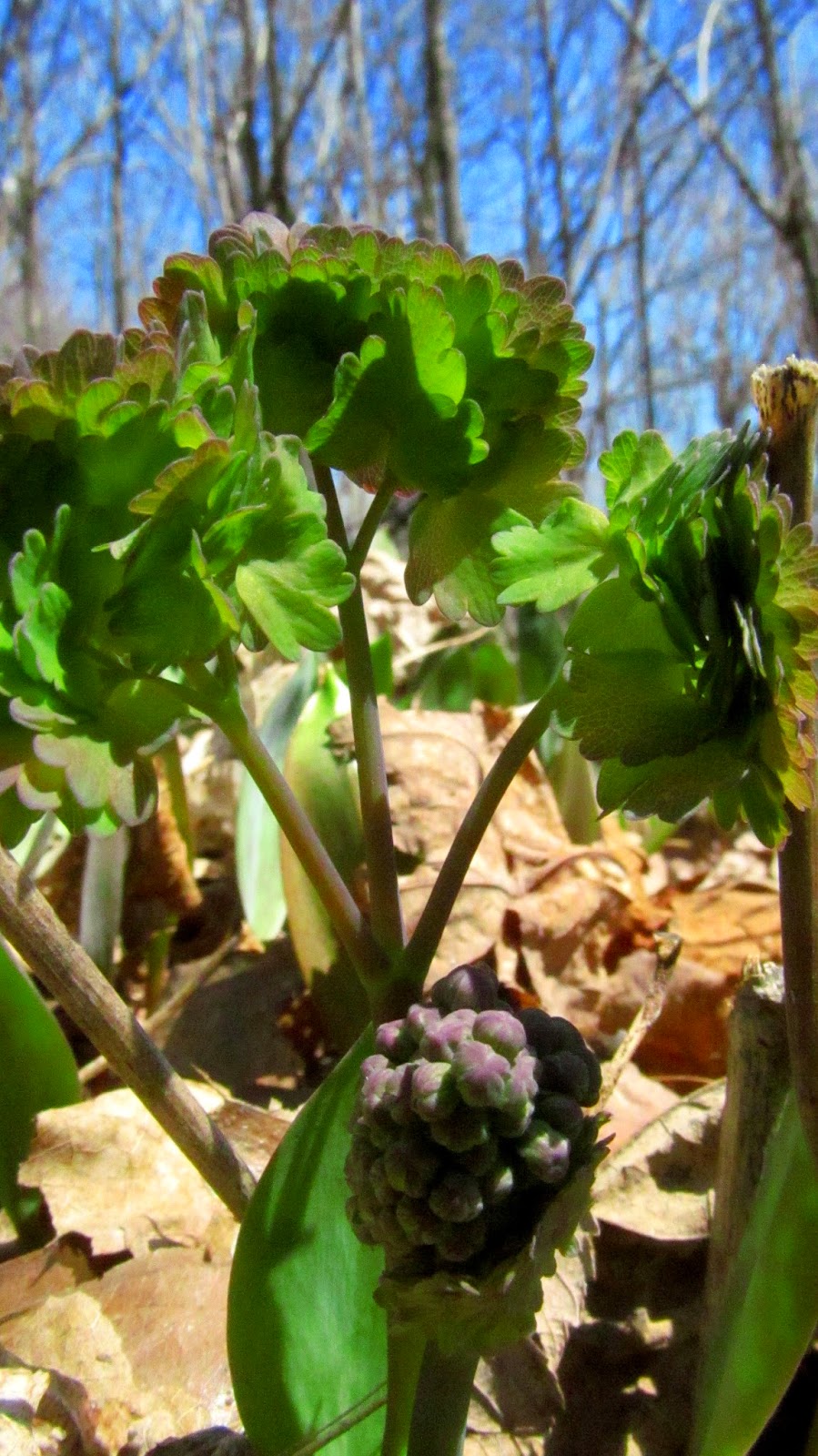
This plant is a perennial and a spring ephemeral. I noticed that it had started to emerge on May 2. Here is a picture of what the young, emerging plant looks like:

Thalictrum dioicum sprouting - note the furled leaves and the emerging flower stalk, with tightly closed buds
This species is wind-pollinated [4], a fact which shows very clearly in the structure of the flowers. Like most other anemophilous (wind-pollinated) plants in the angiosperm lineages, the display parts of the flower (petals, sepals) are either absent or much reduced; T. dioicum has 4 small sepals but no petals [4]. There is no scent, and no nectar [4].

Thalictrum dioicum male inflorescence - notice the sepals, which are spread up and almost flat above the dangling anthers - there are four on each flower, but they are small and unassuming ; note the absence of petals
T. dioicum is a dioecious species [4], meaning that each individual is either male or female but never both. It is easy to distinguish between the two when they are blooming, as the male flowers are staminate (contain stamens), and the female flowers are pistillate (contain pistils).

The two sexes are easy to distinguish. The males have visibly pendulous anthers which are quite numerous. This configuration makes it easy for pollen to become airborne whenever there is a wind gust.

Thalictrum dioicum - staminate (male) flowers - note the dangling stamens
The pistillate (female) flowers, meanwhile, look quite different. They are composed of pistils, and because reproductive success relies on the pistils sifting pollen from the air, they fan out a bit relative each other and are visibly thick and fuzzy - these characteristics increase the flowers' capacity to sift pollen from passing air currents and therefore improves the odds of fertilization.

Thalictrum dioicum - pistillate (female) flowers - note the fanning pistils
In my meanderings, I noticed what appeared to be two quite distinctive colourings for T. dioicum's staminate (male) inflorescences. The above-pictured individual had a yellowy-green-brown cast, while the individual below has a distinctively red-brown colour:

Red-tinted Thalictrum dioicum staminate inflorescence
The red tint also is visible, in these photographs, on all parts of the flower: the darker sepals, the red-tinted filament (thin part on which the anther sits) and the anther (pollen-producing portion, thicker part).

Close-up of the red-brown individual shows that the colour difference is present in the sepals (green but with purplish veins), filaments (visibly red-brown), and anthers (red-brown tint as well as yellowish portions)
In my various readings, I haven't found any indication that there is any documented polymorphism (polymorphism: distinctive groupings for shape or colouring) in this species, not even in the more extensive reports, like this one produced by the US Forest Service. So, I hazarded the guess that the difference in colouring between these two individuals is related to other factors, eg the soil composition or age of the flower. I set out to test the age of the flower hypothesis by going to re-photograph the two individuals pictured here (fortunately I remembered where I photographed them!). 

However, when I returned I found that neither individual showed any colour change over time, and both were arriving at senescence.

So there was no change in colour even as they senesced. Curiouser and curiouser. Therefore the difference is likely not related to the age of the flower. Is this polymorphism? If it is, I would have to wonder why; polymorphism is usually believed to be pollinator-mediated, and for obvious reasons pollinator perception doesn't really come into play for a wind-pollinated plant. 

There is also the possibility that individual b is a different species of Thalictrum, of which there are several, eg Thalictrum occidentale, Thalictrum fendleri, Thalictrum venulosum; however, these species have quite distinctive-looking females and I only saw Thalicturm dioicum females on the mountain. An interesting conundrum. If you have a positive ID or an explanation, I would be very glad to hear from you.

Wednesday, May 6, 2015

Blue Cohosh - Caulophyllum giganteum - Caulophylle géant

In my meanderings yesterday, I came across a single individual of the species Caulophyllum giganteum which was in bloom. This species and another, Caulophyllum thalictroides, are both colloquially referred to as blue cohosh. Indeed, until relatively recently (20 years ago), the two were treated as a single species. They can be distinguished in a few ways that are relevant to us: the first way, which is most obvious right now, is that C. giganteum blooms about two weeks earlier than C. thalictroides [1]. The flowers are also more obviously blue-tinted and less abundant in C. giganteum, and yellow to greenish and more abundant in C. thalictroides [1]. C. giganteum also has a more restricted range than C. thalictroides (combined range map). The style is long in C. giganteum and short in C. thalictroides [1].

C. giganteum in bloom
Although they are separate species, they have quite a lot of characteristics in common [1]. Both are predominantly insect-pollinated with minimal self-pollination [1], and both are considered a traditional women's herb, which was used to treat labour pains or to induce labour, as an abortefactant, and as a contraceptive; it is believed that these plants contain a compound with estrogenic properties [1], but there is presently insufficient evidence to support its use as a medicinal treatment [1,2], and moreover can be quite dangerous and as such is listed as an herb to avoid without prescription and consultation with a doctor [3], as it can have serious harmful effects both on a woman taking the herb, and potentially on a child in the womb as it is also a suspected teratogen [1]. In short, do not use this herb for self-medication under any circumstances, and if discussing the possibility with a doctor, be aware of the side effects associated with its use.

The conservation status of C. giganteum is secure in Canada [4] and secure in the United States, except in Tennessee, where it is listed as threatened [5], likely due to overexploitation [1] (people harvesting too many of the plants and consequently damaging their ability to sustain their population).

The conservation status of C. thalictroides is secure in Ontario and New Brunswick, unknown in Quebec, and potentially at risk in Manitoba and Nova Scotia, with a country-wide ranking of secure [6]. In the United States, it is secure except in Rhode Island where it is threatened [7], again likely due to overexploitation.

C. giganteum flowers; note the distinctive blue and red tints, and the diagnostic long style

Sunday, May 3, 2015

The Race Against Time: Spring Ephemerals

An ephemeral plant is a plant which has a very short life cycle, which takes place during a brief window of opportunity for growth due to environmental factors.

In my neck of the woods, the type of ephemeral plant that we see is the spring ephemeral. Spring ephemerals are perennials which grow in wooded areas. Spring ephemerals are wildflowers; the most crucial characteristic to keep in mind about them is that they are small/short.

Sunlight is a resource which, in the forest, is in short supply; woody plants (shrubs, trees) compete with each other for sunlight by growing higher than others. This strategy isn't an option for spring ephemerals.

So what can a spring ephemeral plant do in order to survive and reproduce in a place where woody plants take up all the sunlight? Well, that's the key... they don't take up quite all the sunlight, not in northern climates where deciduous trees shed their leaves each fall and produce new ones each spring. There's plenty of sunlight hitting the forest floor between fall and springtime.

Spring ephemerals are plants which take advantage of the brief window of time between the snow melt and the closure of the canopy, where there is abundant sunlight hitting the forest floor, warmth, and reasonable insect pollinator activity.

Carpet of Dicentra sp. leaves in the wooded section of the Notre-Dame-des-Neiges cemetery, taking advantage of the brief window of sunlight to spread their leaves and make as much sugar as possible
Spring ephemerals are perennials in large part because the window of resource availability is so brief that it is essential to have some form of stored energy to get a head-start -- so spring ephemerals tend to have bulbs, rhizomes, or tubers which store energy over the winter and can be used to put out a spurt of rapid growth before sunlight is received to produce more energy.

Some spring ephemerals even set their flowers in the fall prior to their reproductive season (eg T. farfara) to broaden even more the amount of time that they can take advantage for reproduction early in the year.

The period of sunlight availability is a few weeks at most, so the plants must race to put up their leaves as quickly as possible to start producing sugars that can be used to make their flowers with the metabolically expensive nectar that attracts pollinators, and the similarly expensive seeds and fruit that are produced for reproductively successful flowers. They have all sorts of interesting adaptations for this, which I have talked about in a few of my posts about spring ephemerals already on this blog. A few examples of spring ephemerals found in Ontario and Quebec include:

-Claytonia spp.
-Thalictrum dioicum
-Thalictrum thalictroides
-Caulophyllum thalictroides
-Tussilago farfara (introduced)
-Scilla siberica (introduced)
And others

The spring ephemerals had better hurry. The leaves are already starting to emerge on some of the trees, like this Salix x sepulcralis (weeping willow) I noticed nearby already looking green and lively:

Salix x sepulcralis with leaf buds already opening

Saturday, May 2, 2015

Insects are Harsh: Large Bee-Fly - Bombylius major - Grand bombyle

It was remarkably nice out today, so I decided to head out to the mountain with my camera to enjoy the weather and to see if the insects had started to wake up. They certainly have! In the various places where the spring ephemerals were in bloom, virtually no flower sat untouched for more than a few moments while I was observing. The pollinators are out in full force. I didn't see any Bombus spp or Apis spp, though. Just a variety of solitary bees, some Syrphid flies, a single Pieris rapae (cabbage white butterfly), and of course a large bee-fly.

The large bee-fly is a member of the Bombyliidae (bee flies) family, a group of bee flies (Order Diptera). Though they are flies, they are bee mimics. Mimicry generally is selected for when the mimicry is of a species to which predators are either indifferent or avoidant.

Unfortunately, the Bombylius major individual I spotted today pollinating T. farfara in the Notre-Dame-des-Neiges cemetery refused to hold still. It's quite tricky to locate an individual, pursue it until it lands, orient the camera in close without scaring the insect away, focus correctly, then take the photo. So, I have only the one photo, which is not great.

B. major pollinating T. farfara
In any case, B. major is a great example of the harshness of nature. B. major is a parasitoid of ground-nesting insects [1] (particularly solitary bees of the genus Andrena) [2]. The major difference between a parasitoid and a parasite is the outcome for the host. A parasite may reduce the fitness and competitiveness of the host, but doesn't assure its death or inability to reproduce; a parasitoid will eventually either sterilize or kill its host.

So B. major's basic method is to seek out ground nests (eg those of Andrena spp.) and deposit their eggs or larvae nearby so that they can crawl into the nest. The larvae then will attach themselves to the Andrena young, feed off them, and eventually kill them. Failing this, B. major will deposit the larvae on flowers that Andrena queens might visit, so that the larvae might be carried off into the nests. [3]

I witnessed a huge number of solitary bees visiting T. farfara today, so this B. major individual will have no shortage of potential hosts for its young.

Harsh.

Bonus photo of S. siberica, just to have something pretty to look at in this post:

Scilla siberica

Thursday, April 23, 2015

Colt's Foot - Tussilago farfara - Tussilage

On our walk on Sunday, E and I encountered Tussilago farfara (colt's foot, fr: tussilage) already in bloom, even though there was still snow on the ground in some places.

Tussilago farfara
T. farfara is a spring ephemeral, a plant which blooms in the brief period between snow melt and the closure of the forest canopy (the emergence of leaves on the trees), when there is light in the forest understory.

This plant is among the first bloomers this year. It often is, as it actually sets its flower buds in the fall prior to the season, a strategy which allows for the earliest possible emergence of flowers. Indeed, at this stage T. farfara does not have any leaves out. They will emerge only later, once the flowers have matured (and once the plant has been exposed to enough sunlight to produce new leaves). T. farfara is a rather unassuming plant later in the season, producing short, heart-shaped leaves in clusters.

Tussilago farfara inflorescence. Note the absence of leaves at this stage of the season.
The flowers are actually a cluster of florets, of which the long ones are fertile, and the ones in the inner disc are infertile. After pollination, they produce seeds which superficially resemble those of dandelions. They have a tuft of light material attached which assists in wind dispersal.

T. farfara is an introduced species in North America, being originally native to Europe. It was brought over as a medicinal plant, but note that we have since determined that it is a toxic plant which can cause serious liver damage. Some varieties without the toxic chemicals have been cultivated in Europe, but these are only in commercial settings; the wild plants are toxic.

This plant is also listed in the Ontario weed registry. It occurs primarily in disturbed areas, particularly along roads.

Wednesday, June 4, 2014

Bloodroot - Sanguinaria canadensis - Sanguinaire du Canada

Sanguinaria canadensis (bloodroot, fr: sanguinaire du Canada) is an herbaceous perennial from the family Papaveraceae. It, like many of the others I've talked about in the last week, has ant-dispersed seeds (myrmecochory), so its seeds have elaisomes. S. canadensis is bee-pollinated. The flowers senesce very quickly after pollination so the floral display is quite short-lived in this plant.

S. canadensis
Leaves are broad, rounded, highly variable in toothedness, and basal only. There is one flower on a single stalk on each plant. Petals are white, androecium is yellow. A readily identifiable plant in the early spring.

S. canadensis is called bloodroot because of the red juice found in its roots. This juice is composed mostly of sanguinarine, which is a pretty powerful toxin. Sanguinarine kills animal cells and has been known to result in serious scarring when applied to the skin and in death from ingestion. Please, do not mess about with the juice of this plant.

There are a few extremely preliminary studies which suggest the possibility that sanguinarine might be helpful in the treatment of cancer. However, these results are very preliminary indeed and DO NOT justify sanguinarine being touted as a cancer remedy; considerably more research is needed to determine if and how it could be used as a treatment for cancer. We simply do not know enough about it right now and people are more likely to do themselves harm than good trying to use sanguinarine to treat cancer. Note that S. canadensis is on the FDA list of false cancer 'cures' to be avoided.

S. canadensis
S. canadensis is secure in most of Canada but may be at risk in Manitoba. Be advised, therefore, that particularly if you are in Manitoba you should take care not to damage this plant unnecessarily.  S. canadensis, in the more southern part of its range in the US, is mostly unranked but listed as exploitatively vulnerable or special concern in two states.

Tuesday, June 3, 2014

Trout Lily - Erythronium americanum - Érythrone d'Amérique

Erythronium americanum (trout lily, fr: Érythrone d'Amérique) is a very long-lived forest understory perennial from the family Lilaceae. It is a spring ephemeral (meaning that the plant emerges and senesces before the forest canopy has closed). This plant is most easily identified by its mottled grey and green leaves; each plant produces either one or two of these leaves, which are arranged basally. The flower is yellow, sometimes with red or purple spots toward the inside; there are six tepals, which can be heavily recurved. The flower is slightly nodding, pointing the ground.

E. americanum - all major points of anatomy visible
The above photograph was taken without damaging the plant; I gently bent the flower stalk down and righted it when I was done. These plants rely on a very narrow window of sunlight in the early spring to store energy in the rhizome for growth and blooming the following year, so it is best to damage them as little as possible.

Note that the anthers are of varying lengths and sizes. They look red here because they have not yet opened to expose the pollen (this flower had opened the same morning that I took the photo).

This flower blooms extremely rarely; some estimate that only about 1/60 plants will bloom in a given year. My observation suggests that this number could be lower in some places, such as where I took these photographs at QUBS. The plants take several years to achieve reproductive maturity, and once achieving it will bloom only occasionally.

E. americanum  - note the heavily recurved sepals

This plant is particularly suitable for certain types of pollination studies where one wants to know which individuals are successfully pollinating other individuals. This is because there is a naturally occurring difference in pollen colour in some of these individuals; the general population has yellow pollen, while occasionally an individual has brown pollen. This allows researchers to take an individual with brown pollen, plant it in amongst individuals with brown pollen, and actually track exactly where the brown individual's pollen ends up going. There are techniques to do this with plants which don't have different flower morphs, but they generally entail putting a fluorescent dye on the pollen and this does somewhat alter its characteristics, eg weight (and is therefore a potential confound).


E. americanum
E. americanum is listed as secure in Canada and secure in most of its US range, except in Iowa where it is threatened.

Saturday, May 31, 2014

Dutchman's Breeches - Dicentra cucullaria - Dicentre à capuchon

(English below)

Cette fleur fait parti de la famille Papaveraceae (pavots). La plante entière est toxique et grâce à cela elle évite de se faire consommé par les chevreuils. La prédation des chevreuils a des effets nuisibles aux fleurs du printemps.

D. cucullaria
La toxicité de Dicentra cucullaria est grâce aux alcaloïdes qui s'y retrouvent.

D. cucullaria est pollinée par une espèce unique d'abeille: Bombus bimaculatus. La reine de B. bimaculatus sort de la terre le printemps en même temps que D. cucullaria commence à fleurir et elle est la seule insecte capable d'obtenir le nectar. Le nectar se retrouve dans les éperons de la fleur, qui sont en haut; pour y accéder, il faut séparer les deux pétales extérieures de la corolla. Ceci exige plus de force que la majorité de pollinateurs sont capable d'atteindre. Seule la reine de B. bimaculatus est capable. Les deux espèces, par conséquence, ont des impactes l'un sur l'autre sur le trajet évolutionaire. Ceci agit de coévolution.

D. cucullaria inflorescence; inflorescence de D. cucullaria

Comme le nectar est très attirant et vaut la peine d'obtenir, il y a d'autres insectes qui on une autre stratégie. Il y a des insectes qui percent le corolla pour y voller le nectar, en ce faisant évitant l'exigance de force pour le prendre.

D. cucullaria with evidence of nectar robbing (note the holes in the corolla); évidence du vol de nectar sur D. cucullaria (noter les trous dans le corolla)
This flower is part of the Papaveraceae (poppy) family. The whole plant is toxic and because of this it has avoided deer predation. Deer predation has had serious negative impacts on spring ephemerals in many places.

D. cucullaria's toxicity comes from a number of harmful alkaloids found in its tissues.

This species is pollinated by Bombus spp. queens, primarily a single species: Bombus bimaculatus. The B. bimaculatus queen emerge from underground in the spring at the same time that D. cucullaria starts to flower and she is the only insect able to get the plant's nectar. The nectar is stored in the nectar spurs of the flower, which are pointing upward in this flower. In order to get the nectar, it is necessary to separate the two outer petals of the corolla; this requires considerable strength, which the majority of pollinators simply do not have. Only the B. bimaculatus queen does (of the pollinators out during the blooming season of D. cucullaria). The two species have thus impacted each others' evolutionary processes. This is called coevolution.

Given that the nectar is attractive and is worth some effort to collect, there are also insects who use a different strategy to get it. There are nectar robbers as well, who pierce the corolla to get the nectar, thus avoiding the strength requirement. Naturally, this provides no benefit to the flower (no pollination occurs).