Wednesday, May 13, 2015

Norway Maple - Acer platanoides - Érable plane

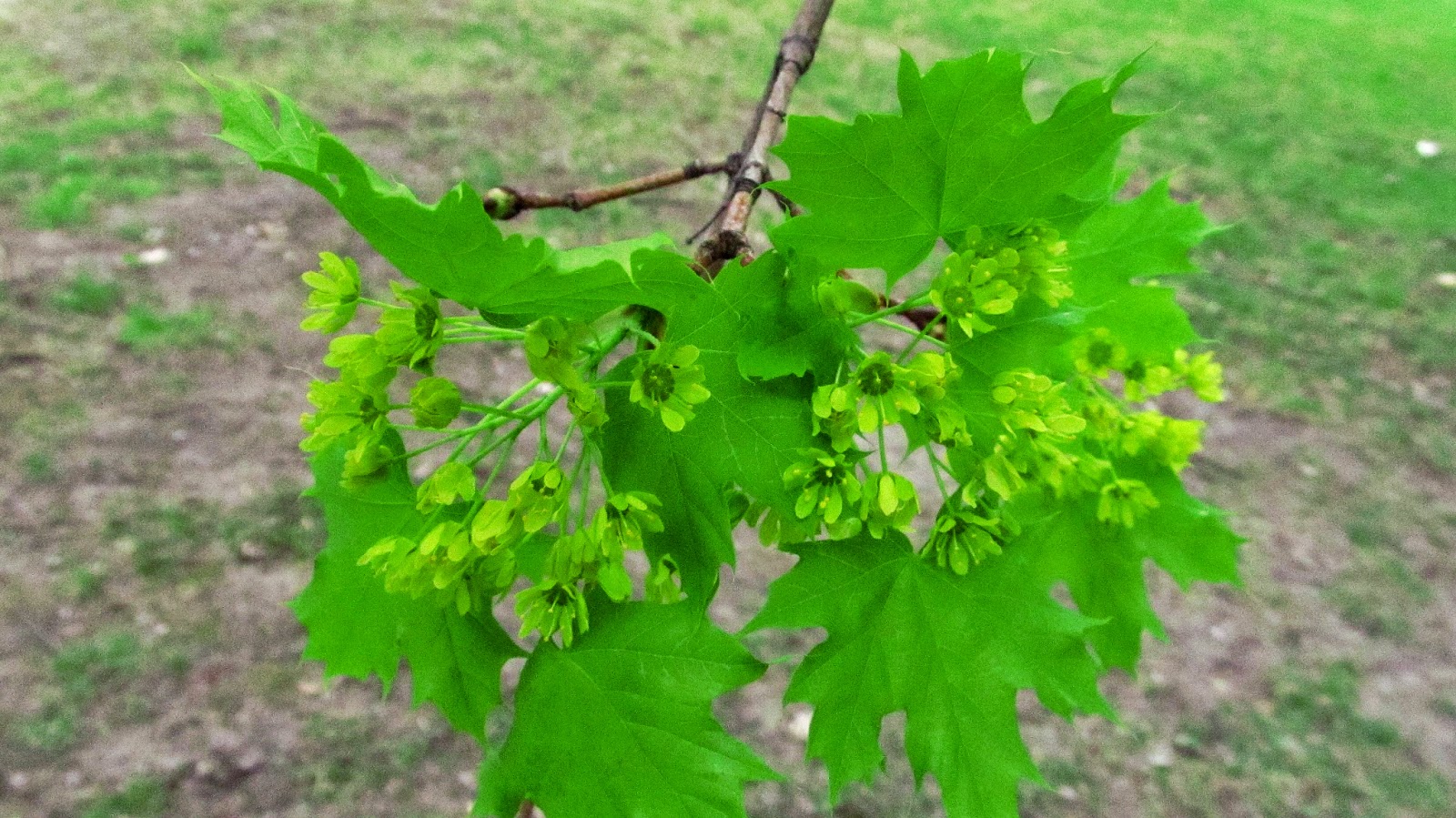
This maple has been blooming vigorously in Montreal for a little over a week now, no surprise as it is an early bloomer.

A. platanoides
Though it looks similar to the native Acer saccharum (sugar maple), this species is an introduced ornamental which is extremely popular in cities for its tolerance to a wide variety of environmental conditions [1]. The species is native to eastern and central Europe [2], but is naturalized in parts of North America particularly the northeastern US [1,3]. Exact distribution maps for this species are unfortunately not available at present; due to its popularity as an ornamental and its potential to spread into wild habitats as a result of its introduction in lanscaped areas, it is not presently known exactly how widely distributed the species is [4]. At any rate, it is classed as an invasive species in the US [1,2,3,4] and Canada [1,2,4]

A. platanoides flowers
A. platanoides ornamental varieties with red leaves such as the popular Crimson King cultivar [5] have been bred as well and are very popular.

A. platanoidies, cultivar Crimson King
This species' invasiveness is cause for some concern, particularly as it inhibits understory plants beneath it [1,3,4] and could not only crowd out native maple species such as the economically important A. saccharum (sugar maple, the source of maple syrup), but also other native trees such as beech [1,3,4]. There is the possibility that an observed reduction in understory diversity below A. platanoides could also result in loss of understory herbs and shrubs, but at present there isn't any data to back the idea up [4].

A. platanoides, cultivar Crimson King : flowers
This is an animal-pollinated species[1,4], visited by Bombus spp. and Andrena spp. [1]. That it is animal-pollinated rather than wind-pollinated shows in the structure of its flowers. Note the presence of sepals, petals, stamens, and pistils -- these are 'perfect' or 'complete' flowers, bearing all of the basic characteristics of a standard animal-pollinated flower (note that they are also monoecious, as indicated by the presence of both male -- stamen -- and female -- pistil -- parts on the same flower and tree) :

Complete flowers on A. platanoides - note that though the pistil is small, it is present
The pistil is a bit more visible in the flowers of the cultivar Crimson King. It's the red part in the centre:

Complete flower on A. platanoides, cultivar Crimson King
The simplest method for an amateur to distinguish between A. platanoides and A. saccharum is to break one of the leaves from the stem and squeeze a bit; if the sap is clear, it's A. saccharum, whereas if the sap is milky, it's A. platanoides [1,3,5].

Friday, May 8, 2015

Remarkable Profusion: Trout Lily, Erythronium americanum, Érythrone d'Amérique

I made a post about Erythronium americanum last year, in which I noted that the plant blooms rarely (due in large part to the fact that it can take an individual seven or eight years to reach sufficient maturity to start blooming [1,2,3]. I happened across some E. americanum colonies in the Notre-Dame-des-Neiges cemetery and the Mont-Royal park on May 2 which were evidently quite old, mature stands, as they were profusely blooming:

Mature colony of Erythronium americanum
I commented on myrmechory (ant-vector) as a seed dispersal method for E. americanum in the previous post, but did not say much about vegetative propagation. E. americanum actually reproduces more through vegetative than sexual means [3]. The extremely close proximity of the individuals in the colonies, and the fact that the colonies appear to be composed of a single type with respect to pollen morph (E. americanum has two varieties: yellow pollen and red pollen), suggest that within-colony, increases in numbers can be mostly accounted for by vegetative reproduction.

This year, I was able to get some good clear photographs showing the two different pollen morphs which I discussed in the last post:

E. americanum red pollen morph
E. americanum yellow pollen morph
I discuss in my previous post about this flower how this natural variation can be used to test hypotheses about pollen movement in wild settings.


All parts of this plant are edible, but emetic [1,4], so although they can be eaten they will tend to make you puke. If you are going to eat them, please bear in mind when collecting E. americanum the incredible length of time it takes for the plant to reach reproductive maturity and harvest sparingly; do not harvest at all in places where E. americanum is threatened such as Iowa or where its status is unknown such as in Newfoundland & Labrador.

This is a very attractive flower. I managed to get quite a few good photographs that really show the form of E. americanum in all its attractive glory.

E. americanum
E. americanum flower bud
Clump of E. americanum

Wednesday, May 6, 2015

Blue Cohosh - Caulophyllum giganteum - Caulophylle géant

In my meanderings yesterday, I came across a single individual of the species Caulophyllum giganteum which was in bloom. This species and another, Caulophyllum thalictroides, are both colloquially referred to as blue cohosh. Indeed, until relatively recently (20 years ago), the two were treated as a single species. They can be distinguished in a few ways that are relevant to us: the first way, which is most obvious right now, is that C. giganteum blooms about two weeks earlier than C. thalictroides [1]. The flowers are also more obviously blue-tinted and less abundant in C. giganteum, and yellow to greenish and more abundant in C. thalictroides [1]. C. giganteum also has a more restricted range than C. thalictroides (combined range map). The style is long in C. giganteum and short in C. thalictroides [1].

C. giganteum in bloom
Although they are separate species, they have quite a lot of characteristics in common [1]. Both are predominantly insect-pollinated with minimal self-pollination [1], and both are considered a traditional women's herb, which was used to treat labour pains or to induce labour, as an abortefactant, and as a contraceptive; it is believed that these plants contain a compound with estrogenic properties [1], but there is presently insufficient evidence to support its use as a medicinal treatment [1,2], and moreover can be quite dangerous and as such is listed as an herb to avoid without prescription and consultation with a doctor [3], as it can have serious harmful effects both on a woman taking the herb, and potentially on a child in the womb as it is also a suspected teratogen [1]. In short, do not use this herb for self-medication under any circumstances, and if discussing the possibility with a doctor, be aware of the side effects associated with its use.

The conservation status of C. giganteum is secure in Canada [4] and secure in the United States, except in Tennessee, where it is listed as threatened [5], likely due to overexploitation [1] (people harvesting too many of the plants and consequently damaging their ability to sustain their population).

The conservation status of C. thalictroides is secure in Ontario and New Brunswick, unknown in Quebec, and potentially at risk in Manitoba and Nova Scotia, with a country-wide ranking of secure [6]. In the United States, it is secure except in Rhode Island where it is threatened [7], again likely due to overexploitation.

C. giganteum flowers; note the distinctive blue and red tints, and the diagnostic long style

Tuesday, May 5, 2015

Manitoba Maple - Acer negundo - Érable negundo

So the most recent tree to go into full bloom here in Montreal is Acer negundo (Manitoba maple). The long, pendulous male flowers are quite eye-catching at the moment.

Acer negundo staminate inflorescences
Like Acer saccharinum, A. negundo is wind-pollinated. Unlike A. saccharinum, A. negundo is dioecious [1,2,3], which means that each tree is either male or female. As with A. saccharinum (and other wind-pollinated species), the flowers are not perfumed or showy, as there is no point in investing energy in characteristics which are used exclusively to attract pollinators. Instead, wind-pollinated plants invest energy in producing a huge amount of pollen to make up for the tremendous inaccuracy of wind-pollination.

Acer negundo staminate inflorescence
A. negundo is introduced in this region, being native to places in the U.S. and in central Canada [native range map here]. This tree is a popular choice for landscaping, and because of this has been spread globally. This species takes very well to disturbed habitats and so has a tendency to spread in human-occupied land. A. negundo also prospers in riparian areas (transition zone from land to river). The species spreads easily and is naturalized in southern Quebec, New Brunswick, Nova Scotia, PEI, and various parts of the United States [3].

A. negundo staminate inflorescence
There is some variation in the timing of emergence of flowers and leaves in A. negundo, depending on geographical (climate) factors [3]. In some places, the flowers appear first, and then the flowers. As can be seen in the photos I have, at least here in Montreal, the flowers and leaves appear simultaneously; this is likely related to the shorter growing season here compared to more balmy southern climes.

A. negundo staminate inflorescence
Unlike most maples, A. negundo has distinctive compound leaves. Image of leaves here.

Monday, May 4, 2015

Insect Pollination: The Bees are Out Full Force

On my walks on May 2 & 3, one of the things that was hard to miss was the enormous amount of pollinator activity. I did not see any Apis spp. However, I did see a remarkably wide range of solitary bees, some syrphid flies, a single Bombus sp. queen, and of course the Bombylius major I posted about on Saturday. I also saw a single Pieris rapae (cabbage white butterfly) in the cemetery.

I am not able to identify all of the species that I have seen, but I took a number of photographs. It took a great deal of effort to get these shots. It's at times like this that I daydream about being able to buy a telephoto lens. How much easier it would be to take photos of pollinators if I didn't have to get my camera within a few inches of them!

Bombus sp. queen on Trillium grandiflorum
This Bombus sp queen was relatively easy to photograph, as she was rather sluggish. I discovered her pollinating some barely opened Trillium grandiflorum. She was so sluggish, in fact, that I actually managed to catch her in flight (shown below). She appeared to be focusing on the retrieval of nectar during the period I was observing her (note her empty pollen baskets).

Bombus queen in flight, just leaving Trillium grandiflorum after collecting nectar
This Bombus queen, however, was the only bee I didn't have to fight to get photos of this weekend. The rest were considerably faster and shyer.

One individual on whom I at least have a reasonably positive I.D. is this solitary bee visiting Scilla siberica; I believe this to be Andrena barbilabris.

Andrena barbilabris (?) on Scilla siberica
Another individual whom I believe I have identified reasonably reliably is this solitary bee, who I believe is Halictus ligatus, shown here visiting Tussilago farfara:

Halictus ligatus (?) on Tussilago farfara
There are a few more species I managed to photograph as well, but which I have been unable to identify as yet.

Unidentified solitary bee on T. farfara
Unidentified solitary bee on E. americanum
Unidentified solitary bee on S. siberica
There were many more than I managed to photograph over the weekend; I counted at least eight visibly distinct species of solitary bee pollinating the T. farfara, and there may well have been more depending on how visible and obvious the distinguishing characteristics of the species are; without a microscope and a specimen, it can be very difficult to judge. At any rate, the solitary bees especially were numerous and varied.

Sunday, May 3, 2015

The Race Against Time: Spring Ephemerals

An ephemeral plant is a plant which has a very short life cycle, which takes place during a brief window of opportunity for growth due to environmental factors.

In my neck of the woods, the type of ephemeral plant that we see is the spring ephemeral. Spring ephemerals are perennials which grow in wooded areas. Spring ephemerals are wildflowers; the most crucial characteristic to keep in mind about them is that they are small/short.

Sunlight is a resource which, in the forest, is in short supply; woody plants (shrubs, trees) compete with each other for sunlight by growing higher than others. This strategy isn't an option for spring ephemerals.

So what can a spring ephemeral plant do in order to survive and reproduce in a place where woody plants take up all the sunlight? Well, that's the key... they don't take up quite all the sunlight, not in northern climates where deciduous trees shed their leaves each fall and produce new ones each spring. There's plenty of sunlight hitting the forest floor between fall and springtime.

Spring ephemerals are plants which take advantage of the brief window of time between the snow melt and the closure of the canopy, where there is abundant sunlight hitting the forest floor, warmth, and reasonable insect pollinator activity.

Carpet of Dicentra sp. leaves in the wooded section of the Notre-Dame-des-Neiges cemetery, taking advantage of the brief window of sunlight to spread their leaves and make as much sugar as possible
Spring ephemerals are perennials in large part because the window of resource availability is so brief that it is essential to have some form of stored energy to get a head-start -- so spring ephemerals tend to have bulbs, rhizomes, or tubers which store energy over the winter and can be used to put out a spurt of rapid growth before sunlight is received to produce more energy.

Some spring ephemerals even set their flowers in the fall prior to their reproductive season (eg T. farfara) to broaden even more the amount of time that they can take advantage for reproduction early in the year.

The period of sunlight availability is a few weeks at most, so the plants must race to put up their leaves as quickly as possible to start producing sugars that can be used to make their flowers with the metabolically expensive nectar that attracts pollinators, and the similarly expensive seeds and fruit that are produced for reproductively successful flowers. They have all sorts of interesting adaptations for this, which I have talked about in a few of my posts about spring ephemerals already on this blog. A few examples of spring ephemerals found in Ontario and Quebec include:

-Claytonia spp.
-Thalictrum dioicum
-Thalictrum thalictroides
-Caulophyllum thalictroides
-Tussilago farfara (introduced)
-Scilla siberica (introduced)
And others

The spring ephemerals had better hurry. The leaves are already starting to emerge on some of the trees, like this Salix x sepulcralis (weeping willow) I noticed nearby already looking green and lively:

Salix x sepulcralis with leaf buds already opening

Saturday, May 2, 2015

Insects are Harsh: Large Bee-Fly - Bombylius major - Grand bombyle

It was remarkably nice out today, so I decided to head out to the mountain with my camera to enjoy the weather and to see if the insects had started to wake up. They certainly have! In the various places where the spring ephemerals were in bloom, virtually no flower sat untouched for more than a few moments while I was observing. The pollinators are out in full force. I didn't see any Bombus spp or Apis spp, though. Just a variety of solitary bees, some Syrphid flies, a single Pieris rapae (cabbage white butterfly), and of course a large bee-fly.

The large bee-fly is a member of the Bombyliidae (bee flies) family, a group of bee flies (Order Diptera). Though they are flies, they are bee mimics. Mimicry generally is selected for when the mimicry is of a species to which predators are either indifferent or avoidant.

Unfortunately, the Bombylius major individual I spotted today pollinating T. farfara in the Notre-Dame-des-Neiges cemetery refused to hold still. It's quite tricky to locate an individual, pursue it until it lands, orient the camera in close without scaring the insect away, focus correctly, then take the photo. So, I have only the one photo, which is not great.

B. major pollinating T. farfara
In any case, B. major is a great example of the harshness of nature. B. major is a parasitoid of ground-nesting insects [1] (particularly solitary bees of the genus Andrena) [2]. The major difference between a parasitoid and a parasite is the outcome for the host. A parasite may reduce the fitness and competitiveness of the host, but doesn't assure its death or inability to reproduce; a parasitoid will eventually either sterilize or kill its host.

So B. major's basic method is to seek out ground nests (eg those of Andrena spp.) and deposit their eggs or larvae nearby so that they can crawl into the nest. The larvae then will attach themselves to the Andrena young, feed off them, and eventually kill them. Failing this, B. major will deposit the larvae on flowers that Andrena queens might visit, so that the larvae might be carried off into the nests. [3]

I witnessed a huge number of solitary bees visiting T. farfara today, so this B. major individual will have no shortage of potential hosts for its young.

Harsh.

Bonus photo of S. siberica, just to have something pretty to look at in this post:

Scilla siberica