Showing posts with label wild flower. Show all posts

Saturday, July 20, 2013

Milkweed - Asclepias Syriaca - Herbe à la Ouate

Here's a common, easily recognized one: common milkweed (fr: herbe à la ouate), Asclepias syriaca. It's very attractive to butterflies and as such is wonderful to have around, but it's important to keep it out of pastures as it is toxic to a number of grazing animals.

A. syriaca on the shore
There's a hint of red clover and some grasses and hawkweed in the bottom of this image, too, but the focus is on the milkweed. Quite a dramatic plant. I like the effect of the milkweed against the backdrop of the rapids.

Ants collecting nectar from the flowers of a. syriaca
Not only does this flower appeal to bees, it also appeals to ants. I hardly ever see them blooming around here without ants crawling around on them seeking nectar. I like the umbrel shape of the milkweed inflorescence.

A. syriaca inflorescence
I love how thick the flower is. The petals are proportionately extremely thick for their size, giving this flower a stiff, chunky appearance that I find really cool and unusual in a flower. It's quite a dramatic flower even up close. There's a drop of dew visible between the two nearest petals of the flower in the centre here.

Wednesday, July 10, 2013

Oxeye Daisy - Leucanthemum Vulgare - Marguerite

L. vulgare inflorescence
Lovely flower, isn't it? I love the double spiral pattern in the heart (spirals in both directions). This species is invasive and is considered problematic in may parts of North America.

I'm remembering and nurturing childhood dreams today.

Saturday, June 29, 2013

Wood Lily - Lilium Philadelphicum

L. philadelphicum specimen
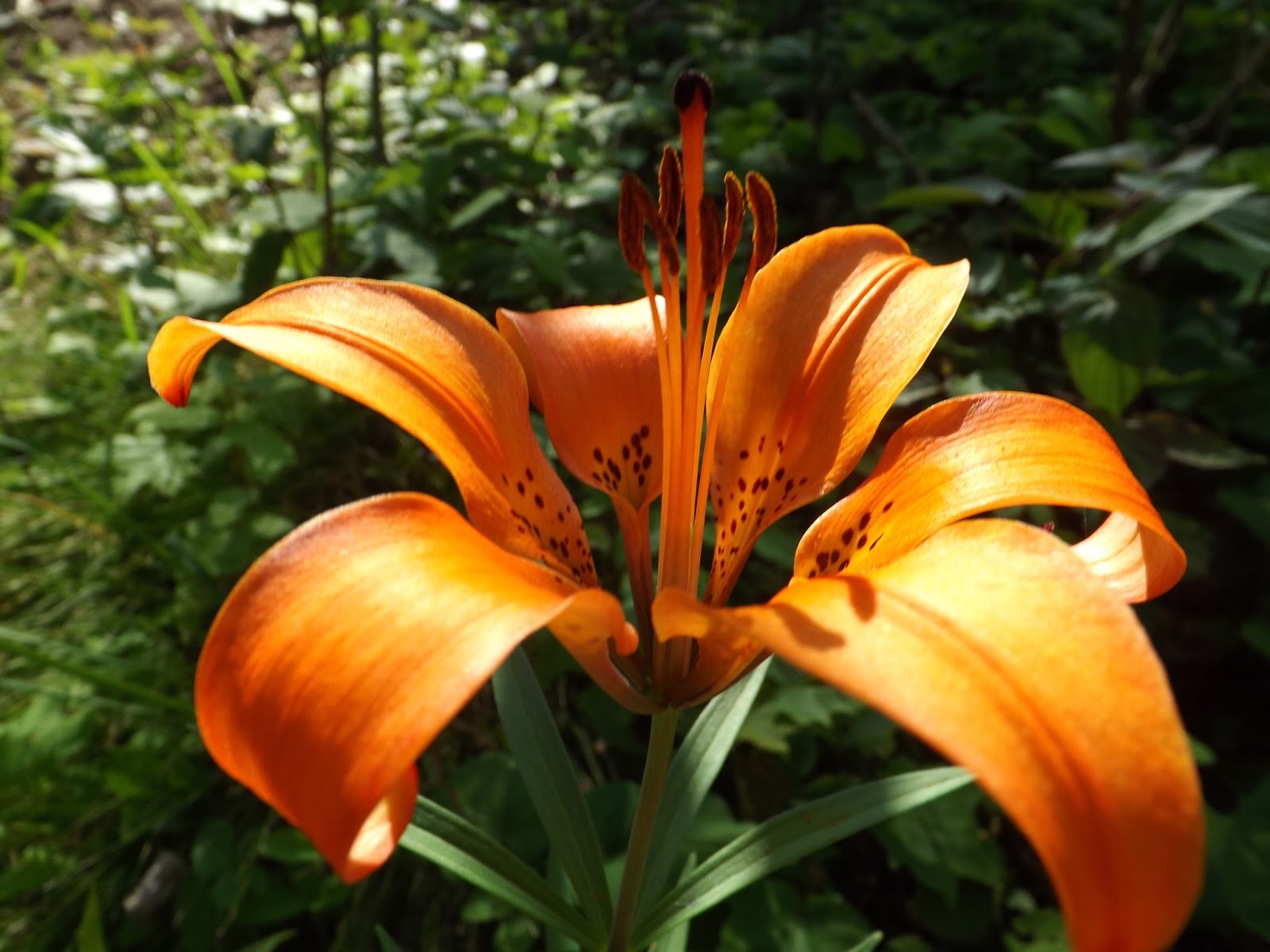
I consider this to be my 'specimen photo'. The anatomy of lilium philadelphicum is quite apparent here. I particularly love the richness of the gradation of colour from bright yellow to deep red. It is a spectacular wildflower. This specimen was growing in loamy soil at the edge of a clearing, in the shade of a stand of cedars. It gets the late afternoon sun (4hrs or so) in its location but the other specimens in the area appeared to be growing in the somewhat more shaded areas (less than 2hrs direct sunlight, but plenty of indirect or dappled sunlight).


L. philadelphicum blossom
The growth pattern of the plant (in threes and sixes) is particularly visible here. The six stamens, lined up with the six petals, and then the tripartite shape of the stigma (upper portion of the pistil, for trapping pollen), is particularly evident in this shot. I love how the points of the stigma are lined up with the three more deeply curled petals. You can also see, from this angle, the tubular section near the base of the petals (quite different, for example, from a day lily, which is of course closed at the base). The clear shadow cast by pistil and stamens is fun.

L. philadelphicum pistil and stamens
And here we take a closer look at the pistil and stamens. I particularly love the way the pollen accumulated on the lens of the camera, resulting in that dappled, sparkly look. The anthers (pollen-producing parts at the tops of the six stamen) look rather like grains of wild rice to me, and the filaments (stalks on which the anthers are located) are beautifully coloured. You can see that the stigma's tripartite appearance from the top is the result of the intersection of three bulbous portions; the curved lower edges are visible from this angle.