Showing posts with label wind pollination. Show all posts

Sunday, May 17, 2015

Early Meadow-Rue - Thalictrum dioicum - Pigamon dioique

Thalictrum dioicum (early meadow-rue) is native to North America (range map here), with a listed global conservation status of secure [1], unlisted in the US [2], and secure in Canada [3] except in Manitoba where its conservation status is unknown [3]. Note that, as with many of the USDA maps, the Canadian range is listed as more limited than the corresponding Plants of Canada database map.

This has happened a few times now with range maps I've looked at recently, so I'm going to take a moment to talk about my stance on disagreements between USDA listings and Plants of Canada database listings. For Canadian range information I will put my faith in the Canadian government source. So if you're in Manitoba with T. dioicum in front of you, scratching your head wondering if you're looking at evidence of the introduction or spread of T. dioicum based on that USDA map-- I doubt it, since the Canadian listing includes Manitoba in the native range of the plant. Ideally I would only draw the data from one source, but the Plants of Canada database maps don't show any information about US distribution at all. Since plants don't care about human borders, it is still informative to determine the rest of the range of the plant. So, two sources it is. In all cases where the two sources disagree about the Canadian range of a plant, I will assume that the data from the Canadian government is more accurate. I won't mention this again in my blog posts.

Thalictrum dioicum in bloom (male)
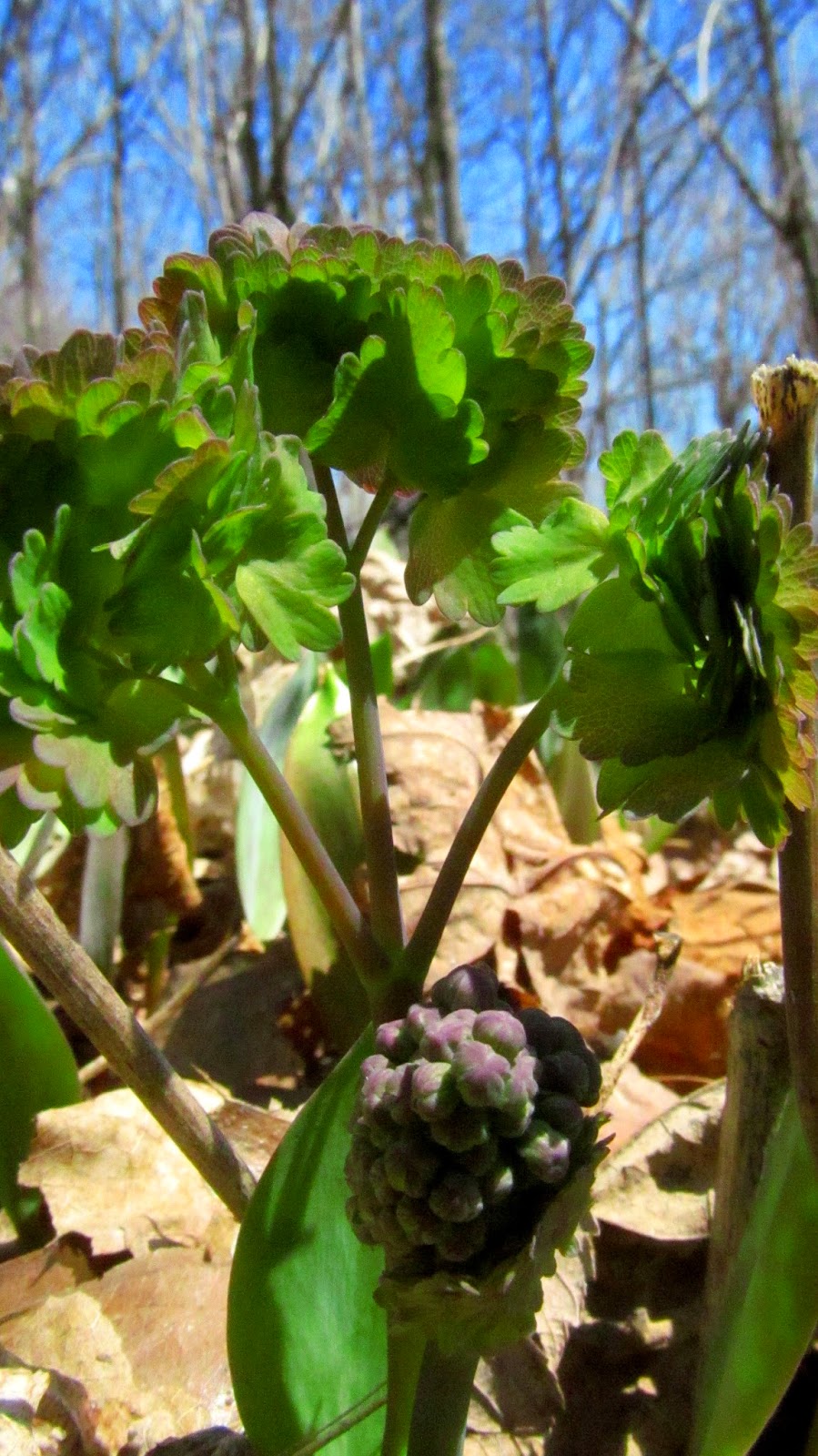
This plant is a perennial and a spring ephemeral. I noticed that it had started to emerge on May 2. Here is a picture of what the young, emerging plant looks like:

Thalictrum dioicum sprouting - note the furled leaves and the emerging flower stalk, with tightly closed buds
This species is wind-pollinated [4], a fact which shows very clearly in the structure of the flowers. Like most other anemophilous (wind-pollinated) plants in the angiosperm lineages, the display parts of the flower (petals, sepals) are either absent or much reduced; T. dioicum has 4 small sepals but no petals [4]. There is no scent, and no nectar [4].

Thalictrum dioicum male inflorescence - notice the sepals, which are spread up and almost flat above the dangling anthers - there are four on each flower, but they are small and unassuming ; note the absence of petals
T. dioicum is a dioecious species [4], meaning that each individual is either male or female but never both. It is easy to distinguish between the two when they are blooming, as the male flowers are staminate (contain stamens), and the female flowers are pistillate (contain pistils).

The two sexes are easy to distinguish. The males have visibly pendulous anthers which are quite numerous. This configuration makes it easy for pollen to become airborne whenever there is a wind gust.

Thalictrum dioicum - staminate (male) flowers - note the dangling stamens
The pistillate (female) flowers, meanwhile, look quite different. They are composed of pistils, and because reproductive success relies on the pistils sifting pollen from the air, they fan out a bit relative each other and are visibly thick and fuzzy - these characteristics increase the flowers' capacity to sift pollen from passing air currents and therefore improves the odds of fertilization.

Thalictrum dioicum - pistillate (female) flowers - note the fanning pistils
In my meanderings, I noticed what appeared to be two quite distinctive colourings for T. dioicum's staminate (male) inflorescences. The above-pictured individual had a yellowy-green-brown cast, while the individual below has a distinctively red-brown colour:

Red-tinted Thalictrum dioicum staminate inflorescence
The red tint also is visible, in these photographs, on all parts of the flower: the darker sepals, the red-tinted filament (thin part on which the anther sits) and the anther (pollen-producing portion, thicker part).

Close-up of the red-brown individual shows that the colour difference is present in the sepals (green but with purplish veins), filaments (visibly red-brown), and anthers (red-brown tint as well as yellowish portions)
In my various readings, I haven't found any indication that there is any documented polymorphism (polymorphism: distinctive groupings for shape or colouring) in this species, not even in the more extensive reports, like this one produced by the US Forest Service. So, I hazarded the guess that the difference in colouring between these two individuals is related to other factors, eg the soil composition or age of the flower. I set out to test the age of the flower hypothesis by going to re-photograph the two individuals pictured here (fortunately I remembered where I photographed them!). 

However, when I returned I found that neither individual showed any colour change over time, and both were arriving at senescence.

So there was no change in colour even as they senesced. Curiouser and curiouser. Therefore the difference is likely not related to the age of the flower. Is this polymorphism? If it is, I would have to wonder why; polymorphism is usually believed to be pollinator-mediated, and for obvious reasons pollinator perception doesn't really come into play for a wind-pollinated plant. 

There is also the possibility that individual b is a different species of Thalictrum, of which there are several, eg Thalictrum occidentaleThalictrum fendleri, Thalictrum venulosum; however, these species have quite distinctive-looking females and I only saw Thalicturm dioicum females on the mountain. An interesting conundrum. If you have a positive ID or an explanation, I would be very glad to hear from you.

Thursday, May 14, 2015

Paper birch - Betula papyrifera - Bouleau à papier

Betula papyrifera is a species native to North America, particularly Canada and parts of the northern US. A native range map for the species can be found here; note that although this map excludes Nunavut from the native range of the species, the Plants of Canada database indicates that the species' native range also includes this territory. This species is well-adapted to cold weather, and tends to grow poorly where summer temperatures are too high [1,2,3].

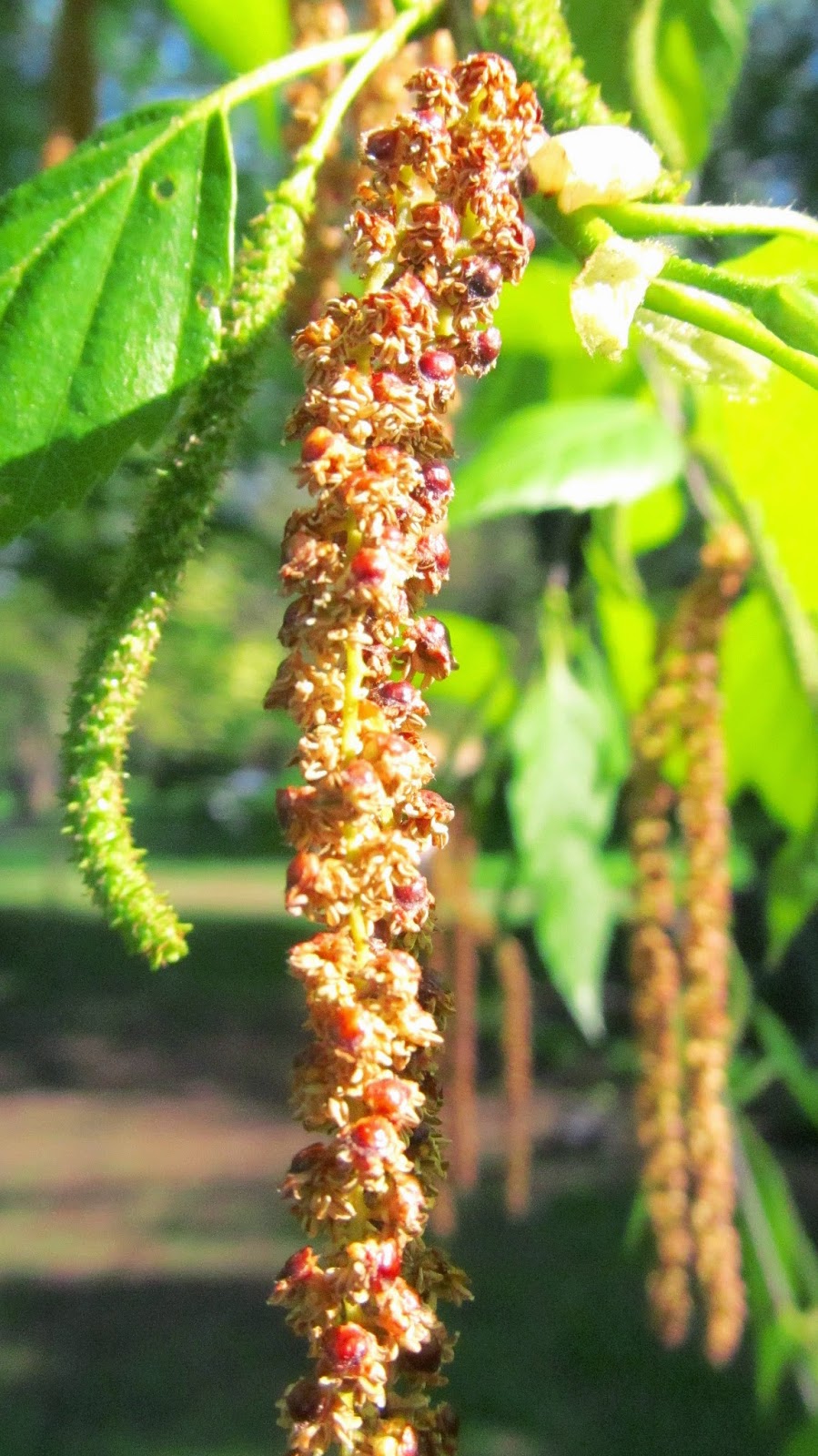
B. papyrifera catkins & leaves
B. papirifera, like many of the maples including A. saccharinum, is wind-pollinated. But, its flowers look quite different: B. papyrifera produces a catkin, a tubular inflorescence (inflorescence: a structure which contains flowers) with no petals or inconspicuous ones, composed of a large number of flowers, usually all of the same sex. The catkin is an inflorescence shape which lends itself well to anemophily (wind-pollination), as the tubular cluster of flowers helps ensure the distribution or sifting of pollen from the air with high efficiency regardless of wind direction. Catkins also tend to be quite unremarkable to look at, as they are not (generally) adapted to attract pollinators.

B. papyrifera female catkin
B. papyrifera male catkin
B. papyrifera is monoecious, meaning that each individual produces both male and female gametes. In the case of B. papyrifera, the individual inflorescences are imperfect, being either staminate (male) or pistillate (female) [4]. Both male and female inflorescences occur on the same tree [4]. B. papyrifera has both male and female catkins. The male catkins are formed in the fall, creating dense clusters of three on branch-tips and overwintering on the branches [5].

One possible reason that the male catkins are set in the fall but the female catkins are not is related to the timing restriction on the use of the types of gamete. The pollination season is relatively short, so male flowers must produce as much pollen as possible as soon as possible in order to ensure that their pollen fertilizes the female flower. In this situation, it makes sense for the male flowers to be set in the fall, permitting the male flowers a head-start on opening in the spring.

The female flowers have to be ready quickly for pollination, but this is not where the most energy is expended for female flowers; the female flowers, once pollinated, must develop and produce the fruit or seed which will then germinate into a new individual. In principle the female flower has the whole growing season to set fruit or seed, so it is not so urgent to have a fully developed female flower as early as possible (indeed, the female flower can't really mature until after pollination has taken place), just one that is receptive to pollen. This can be achieved without setting the flowers in the fall.

The study of timing of floral development and opening is a whole field unto itself, with a wide range of plant strategies for a vast array of reasons, which I will not get into here but may discuss in a dedicated blog post.

B. papyrifera has some interesting characteristics. The bark of this tree is exceptionally weather-resistant, often remaining essentially intact on the forest floor long after the wood has rotted away [6]. This species is sometimes grown as an ornamental, specifically for its attractive white bark [1,2] which is visible in the background of the photo below:

B. papyrifera, white bark in background
B. papyrifera's bark is extremely flammable, making this tree very vulnerable to forest fires [1]. This trait also makes the bark excellent tinder for starting fires, as it will burn hot even when wet [1,5]. That said, please consider the health of the tree and if using this bark to start a fire don't go stripping it off the tree; the tree needs its bark as protection against weather, insects, bacteria, and fungi. Collect it from the ground instead, and make sure to follow all reasonable safety precautions with your fire.

This species is listed as vulnerable in Indiana; it is imperiled in Illinois, Virginia, West Virginia, and Wyoming; and it is critically imperiled in Colorado and Tennessee [6]. In Canada, it is listed as secure in all provinces and territories except Nunavut, where it is sensitive [7]. Please bear the species status in mind when interacting with B. papyrifera and interfere as little as possible in places where the species is at risk.

Wednesday, April 22, 2015

Silver Maple - Acer saccharinum - Érable argenté

So E and I went for a stroll over the weekend and enjoyed the sight of the maples beginning to bloom. Acer saccharinum (silver maple) appears to be the most forward of the maples in our area, already blooming exuberantly.

Abundantly blooming Acer saccharinum
Acer saccharinum is an interesting plant. Although it is a member of the angiosperm (animal-pollinated) lineage, this particular group has returned to wind pollination as a reproductive strategy (pollination syndromes). This fact shows very clearly in the floral morphology (flower shape).

Acer saccharinum - staminate (male) inflorescence. Note the absence of large petals or sepals, and the long stamens which expose the anthers to wind currents. The pollen produced is small and lightweight, which improves its airborne distance.

Acer saccharinum - pistillate (female) inflorescence. Yes, those little fuzzy red protrusions are pistils. They are fuzzy and relatively large in order to best sift pollen from the air.
Anemophilous (wind-pollinated) plants lack sepals, petals, nectar, and perfumes (note that some, like these, can have small or underdeveloped petals or sepals). This is because all of these function to attract pollinators and take up a lot of metabolic energy to produce. So, plants which don't need to attract pollinators will quickly see selection pressure favour inconspicuous, lower-energy flowers. Instead, they invest energy in producing larger quantities of pollen, since wind dispersal is a very imprecise method of fertilization. As a result, the staminae tend to be long and exposed, putting the anthers (pollen-producing portion) in the way of potential wind currents. The pistillae tend to be large and fuzzy in order to better sift and capture airborne pollen.

Acer saccharinum staminate inflorescences
Acer saccharinum is a monoecious plant, but is flowers are unisexual. This means that male and female gametes (pollen and eggs) are both produced on the same plant, but each flower produces either male or female gametes. Note that so far in my observations the trees produce either male or female flowers but not both, but this may vary from year to year; I will defer to the various experts who indicate that this species is monoecious and assume that the individual trees can produce flowers of either sex, and but may express only one in any given year; this also is monoecy. This kind of sex alternation by season has been observed in a number of plants including Arisaema triphyllum.

Acer saccharinum staminate inflorescences
They may not be the showiest flowers in the world, but I love the fluffy, fuzzy appearance of maple trees in full bloom. I find them quite beautiful. Of course, that means that I wouldn't survive long as a pollinator -- I'd waste all my energy visiting flowers that have no reward!

Fortunately for me there's a grocery store nearby, so my poor choice in flower won't reduce my own fitness.