I wrote a few weeks ago about the start of the field season. I have been back up to the field site a couple of times since then mostly for basic surveying and laying out the plots that will stay in place for the next few years.
This week things got serious, though. Our orchids of interest, Cypripedium arietinum (ram's head orchid, fr: Cypripède tête-de-bélier), are finally blooming! This year they're blooming rather later than usual, as I have informal records going back several years showing the orchid flowering by May 17th -- they didn't start this year until May 22nd.
Here's what these little beauties look like:
C. arietinum
These little guys are gorgeous up close, but actually not very showy (at least to the human eye) -- they are very small, generally somewhere between 10 and 25cm tall at the flower (around a handspan off the ground) and the labellum (white and purple-veined petal-looking portion of the flower) is only about 1-1.5cm tall from lip to point, around 1cm wide, and only 1-1.5cm from front to back -- similar in size to the tip of an index finger. Moreover, their sepals (the brownish-red petal-like things sticking up, or out to the sides) are brownish and earlier in flowering development they lean down over the labellum, disguising it from view from above. This position of the sepal over the labellum can be seen in a photo in one of my previous blog posts, here. These factors come together to make C. arietinum a subtle, hard-to-spot little orchid.
C. arietinum flower
One rather interesting aspect of orchid pollination biology is the production of pollinia. Basically, instead of presenting pollen in loose grains that are removed and delivered in small numbers by pollinators, orchids (and a few other plants, e.g. milkweeds) produce their pollen in two big sticky masses called pollinia (singular pollinium) -- a pollinator either leaves with a big blob of sticky pollen, or without any pollen at all. Similarly, a flower receives pollen in big sticky masses. There are a couple of advantages to this kind of system: paternal success per pollinator visit is improved, because if a flower gets an opportunity to sire seed (i.e. its pollinium is transported to another flower), it gets to sire a lot of seed all at once because there are enough pollen grains in the pollinium to fertilize most/all of the available ovules; maternal success per pollinator visit is also improved, for similar reasons to the above. Of course, there's a loss of genetic diversity in offspring, as under these conditions all seeds from the same flower are full-siblings (same paternal and maternal parent), whereas if pollen grains were carried individually or in small numbers many of the resulting seeds would be half-siblings (same maternal parent, but different male parents).
I actually took some photos that show the pollinia of C. arietinum, so let's take a look:
C. arietinum pollinium -- look at the top of the labellum, where we have a fleshy structure below the dorsal (top) sepal -- if you look closely, under that structure (which is composed of filaments and pistil, fused), we see a round yellow blob -- that's the pollinum!
So why would it be better to increase reproductive success per pollinator visit at the expense of genetic diversity of the offspring? Current thought is that it's related to the plant being deceptive (or rather, to the plant receiving very few floral visitors because it's deceptive). I've talked about floral deception before, but in a nutshell the flower lures pollinators in by signalling that it offers a reward (nectar), but once the pollinator arrives it discovers that it's been had, that there's no nectar reward at all. Being food deceptive allows a flower to reduce its investment of energy in pollinator attraction (it doesn't have to make nectar, which is costly), but being food deceptive also means that the flower gets a lot fewer visits, because the pollinators learn that this flower is a liar and not worth visiting.
It's a pretty liar, though, eh? C. arietinum looking into the labellum
Regardless of the delay in their flowering time this year, now that the orchids are blooming the intensive fieldwork starts. We set out several days this week to tag all of the flowering individuals (we're already up over 200 individual orchids), measure a suite of their characteristics, measure soil pH and moisture for each of them, take down canopy closure and other plot characteristics, and note the size of the flowering community around each individual. This is an enormous amount of work, as you might have guessed. And there are still at least 100 orchids left to go!
One of the best things about fieldwork, which I touched on briefly in my last post, is that making close observations out in the field can lead to new questions and new discoveries. For example, yesterday during my fieldwork I noticed something very odd and cool. It won't come as a complete surprise to my blog readers, as I have talked about mutations twicebefore. This time, no fasciation, but instead I found five two-flowered individuals in this species that generally only has one flower per stalk. Individuals producing more than one flower on the same stalk naturally have been documented in quite a few orchids, especially Cypripedium spp.; however, there are a number of possible reasons for the multiple flowers: stress-related growth malfunction? soil contamination growth malfunction? natural genetic mutation? natural morphological variation? When it comes right down to it, we don't currently know the cause.
Of these two-flowered individuals, there seemed to be two broad 'types'. The first is a two-flowered individual wherein the upper flower is right-side-up and the lower flower is upside-down. There were three of this type in one of our study plots. Here are some pictures:
C. arietinum two-flowered individual. The upper flower is on the right, and the lower on the left.
One visible consequence of the orientation of the second (lower) flower is that the bottoms of the labellums of the two flowers press together and result in some distortion of the shape of the labellum -- for all three of this type of two-flowered individual in the plot, the lower flower's labellum was compressed such that the point at the bottom (oriented upward in this flower) was folded back instead of deployed (flower on the left in the above photo), while the upper flower's labellum had its point deployed (flower on the left in the photo below).
C. arietinum two-flowered individual, from the other side -- the upper flower is on the left and the lower on the right
As you may have guessed, the second type of two-flowered individual I saw yesterday during my fieldwork was on in which both the first and second flowers were oriented correctly.
C. arietinum 2-flowered individual with both flowers correctly oriented
Though there's no interference between the two flowers in their growth like with the two-flowered individual above, I did notice that this individual also had some weird sepals on the upper flower -- notably, the dorsal sepal is oddly tilted off to the side (you can't really see it in the photo below, for example), and on that side where the dorsal sepal is the lateral sepals are actually entirely missing, so it's short a pair of lateral sepals and the dorsal sepal is positioned oddly. Because of my low sample size (only two flowers), I have no idea if this weird sepal situation is related at all to the double flowers. The lower flower, though smaller than the upper, appears well-formed.
C. arietinum two-flowered individual showing the flowers up close
I am still mulling over what kind of work we might be able to do with these unusual individuals. We will be limited by our very low sample size, but I live in hope -- maybe there will be more that we haven't spotted yet, as there are quite a few plots left to go! In the meantime, they're a curiosity worth documenting. Maybe this natural history find will turn into an ecological one in future!
I suppose I've had a good ramble through the orchid patch now and will get back to the title of this post, which is ostensibly the main point here. These lovely pictures don't convey one aspect of the season: blackflies! It is peak blackfly season, so it's absolutely brutal out there. We are all wearing bug hats and tucking our pants into our socks, our shirts into our pants, binding our cuffs with rubber bands, wearing gloves, and just about bathing in DEET because the blackflies are ravenous and exceptionally numerous. It takes a special sort of obsession to put up with them for ten hours a day!
I shared this video last year, but it's particularly apropos at the moment. Here's some delightful Canadiana about blackflies, sung by Wade Hemsworth and the McGarrigle Sisters and with animation by the national film board:
I have been working away at my stats, analysis, and writing in the lab since my last post in September about the transition between fieldwork and data analysis. With the melting of the snow, I'm now heading back out into the summer portion of the ecology research cycle: field research!
I will be collaborating with my labmate Cory and his old supervisor on long-term research with the population of Cypripedium arietinum (ram's head orchid) at the lake; I've written about this plant before -- there's a nice photo of the flower over on that post as well so go check it out!
Orchids are interesting for lots of reasons. Here are just a few:
(1) Many orchids are unrewarding, which means that they don't offer nectar to pollinators in exchange for pollen transport. With unrewarding orchids we can investigate questions about the evolutionary consequences and/or adaptive mechanisms for deceiving pollinators into moving pollen from plant to plant
(2) Many orchids are spring ephemerals. This means that they flower in the brief window in the spring after the snow melts and before the trees put out their leaves. Synchronizing with their pollinators, which are just waking up from their winter hibernation, is particularly important for them to successfully reproduce. With these plants, then, we have opportunities to investigate how small- and large-scale variation in climatic conditions (e.g. timing of first snow melt, date of tree leaf bud bursting, quantity of canopy that's open throughout the blooming period, variation in temperatures, etc) can affect the emergence synchronization of flowers and their pollinator.
(3) Orchids rely on fungi in the soil in order to germinate and grow, so we can ask questions about how such a system might evolve and how the orchids and fungi can affect each other over time and space.
Cory and I went out yesterday to get some basic information about the areas where the plants are found, so that we can get a sense of what kind of designs are going to work best.
At the start of the season we're often just exploring a bit, to get a sense of what we have to work with with respect to terrain and space. This kind of knowledge is invaluable for designing studies and making decisions about what kinds of tools and techniques we want to use.
We were delighted to notice that we could pinpoint a few clumps of the plants because we found some old fruiting stalks (seed pods on old stalks) that survived over the winter. They aren't easy to spot because they're small and about the same colour as dead leaves and twigs on the ground, but with a bit of crawling around and some prior knowledge, they can be found.
These old seed pods are great not just to help us locate plants, but also because they allow us to glean a bit of information about last year, too; a rough count of how many old seed pods there were this spring gives us a minimum number of seed pods that were produced last year (we can't know what proportion were lost over the winter, so we can't say how many more than this count were produced).
Old seed pod of C. arietinum
Because these orchids are perennials, finding these old stalks allowed us to locate at least some of the clumps of C. arietinum at our sites. What's more, we even found some very young shoots already coming up!
In the centre of this photo (look closely) there are several little C. arietinum shoots just starting to come up; the white thing is a tag that we put in to mark the location of this clump
Cory and I put in some temporary tags and some flags to mark off the general areas where we know there are plants; this will make our work easier next week when we go back next weekend to install permanent tags for the clumps of C. arietinum, since we're going to want to be able to track them across years.
Cory, next to a pole that he placed to mark one of the areas of the property where we found some C. arietinum clumps
At that point, we'll also start making a GPS map of the coordinates of our populations and clumps for good long-term data maintenance, and as insurance against long-term markers being lost or displaced accidentally.
My husband was recruited as an unpaid but dearly appreciated field assistant; here we are counting old stalks, fruit, and new shoots in a clump of C. arietinum that he found.
We'll be going back throughout the season to track these plants as they grow, bloom, and fruit. I will post some more updates as the season progresses.
Purely out of curiosity, we spent a bit of time fiddling with the old seed pods; we noticed that most of them had opened and dispersed all their seeds, already, but that some still contained seeds and were in varying stages of openness. Those that were partially open were interesting because when shaken or nudged, they sent out clouds of thousands of miniscule seeds! We took a video that is unfortunately out of focus, but you can see the seeds as little blurry pale things in the video clip below:
We also collected a couple of old seed pods from last year that hadn't opened and released all their seeds and spent a few minutes today looking at the seeds under the microscope out of curiosity. We weren't using the fancy Zeiss research scope in the lab upstairs, so there's no camera mount on this microscope and it's not the most amazing scope ever, but I can at least give an idea of what the seeds look like:
C. arietinum seeds; the dark spot in the centre is the seed itself. The old cell walls are visible in this image as dark lines that seem to be outlining somewhat rectangular shapes. This image is at taken at 100X magnification, so the entire structure including coat is maybe 1mm long or a bit less, while the seed is less than that. Tiny!
I am absolutely delighted that the field season has started up again. This is just one of a few projects I'm hoping to work on this year. I will make sure to post a bit more this year than last about what I'm up to and why over the field season.
Another plant currently in bloom is Arisaema triphyllum (jack-in-the-pulpit), a rather intriguing-looking plant with large three-lobed leaves and unusually shaped flowers.
Arisaema triphyllum
This species is native to eastern North America (range maps: North America, Canada). This plant has no protected status listings in the US [1] and is listed as secure in its Canadian range, except in Manitoba where it may be at risk [2].
Arisaema triphyllum
The flower of this plant tends to attract a lot of interest and attention because of its unusual shape. These two structures are called the spathe (the striped, green-purple hood section) and the spadix (the cylinder in the centre). The spadix is actually the inflorescence (structure to which the flowers are attached); the flowers are hidden inside the spathe.
Arisaema triphyllum spathe & spadix
Why would a plant be shaped this way, carefully shielding and reducing access to its flowers? Wouldn't that reduce pollination?
Well, certainly that would be the case if the plant were wind-pollinated. Or if it were pollinated by larger animals eg bats.
But A. triphyllum is pollinated by fungus gnats [3]*. And this plant is a giant jerk about it.
The plant is visited by fungus gnats, which crawl on in to get access to the flowers. But then once they're inside, the size and shape of the hood make it seem totally closed [4]; the flies have a hard time getting out. The male flowers, which have some interest in the pollinator escaping, have a small hole at the bottom of the spathe through which pollinators can escape (after brushing past all the male flowers on the way down) [4]. The females have no such hole, so pollinators are more likely to die in there [4]. But while they're stuck in there they fly around and thrash and generally get themselves coated in pollen, or in the case of the female flowers, coat the pistils with the pollen they've already collected.
So this flower traps its pollinators to increase its odds of successful pollen transfer, and with the female flowers has a high chance of killing the pollinator outright. Harsh.
Other plants do this, of course, with varying degrees of harm. For example, in yesterday's post I talked about Cypripedium acaule, which also traps its pollinators (but it always lets them out!). C. acaule has a one-way hole in the front of the flower through which pollinators enter, and then a sort of pollination-tunnel through which they can exit up around the top of the flower [5]. First, the pollinator is forced to rub past the pistil, which ensures that if they're carrying pollen it's transferred over [5]. Next, they get brushed with a ton of little pollen-covered hairs, ensuring that the pollinator leaves with plenty of pollen for the next flower [5].
Cypripedium parviflorum and Cypripedium arietinum are both also pollinator trappers (sometimes referred to as kidnapping).
Trapping helps to increase the odds of successful pollination when a pollinator does come by, by increasing the odds that pollen will be deposited on the pistil.
A. triphyllum is often considered dioecious [6]; bisexual flowers have been noted but whether these flowers reproduce bisexually is debated [7]. An interesting aspect of this species' gender segregation is that it is not fixed by generation; a given individual can vary its sex from year to year; this sex variation is generally thought to be linked to the size/age (available stored resources in the roots) of the plant [3,4,6,8]. The general idea is that female function (production of fruit and seeds) takes more energy than male function (production of pollen), so a plant with more available resources in its roots, eg one which is larger or one which was able to store more energy the previous year (which would be more possible if it was male the previous year), is more likely to be female for the season.
I did manage to get a photo of a unisexual female, showing the flowers at the bottom of the spathe. I apologize for the poor image quality, I was in a hurry.
Female flowers of Arisaema triphyllum
As you can see, this flower has very plain flowers, just a little fruiting bulb (an ovary) with a pistil on the tip (the white part). Given that their visual characteristics are not related to attracting pollinators, it is no surprise that the flowers are unremarkable to look at; resources are redirected to more valuable functions such as producing fruit.
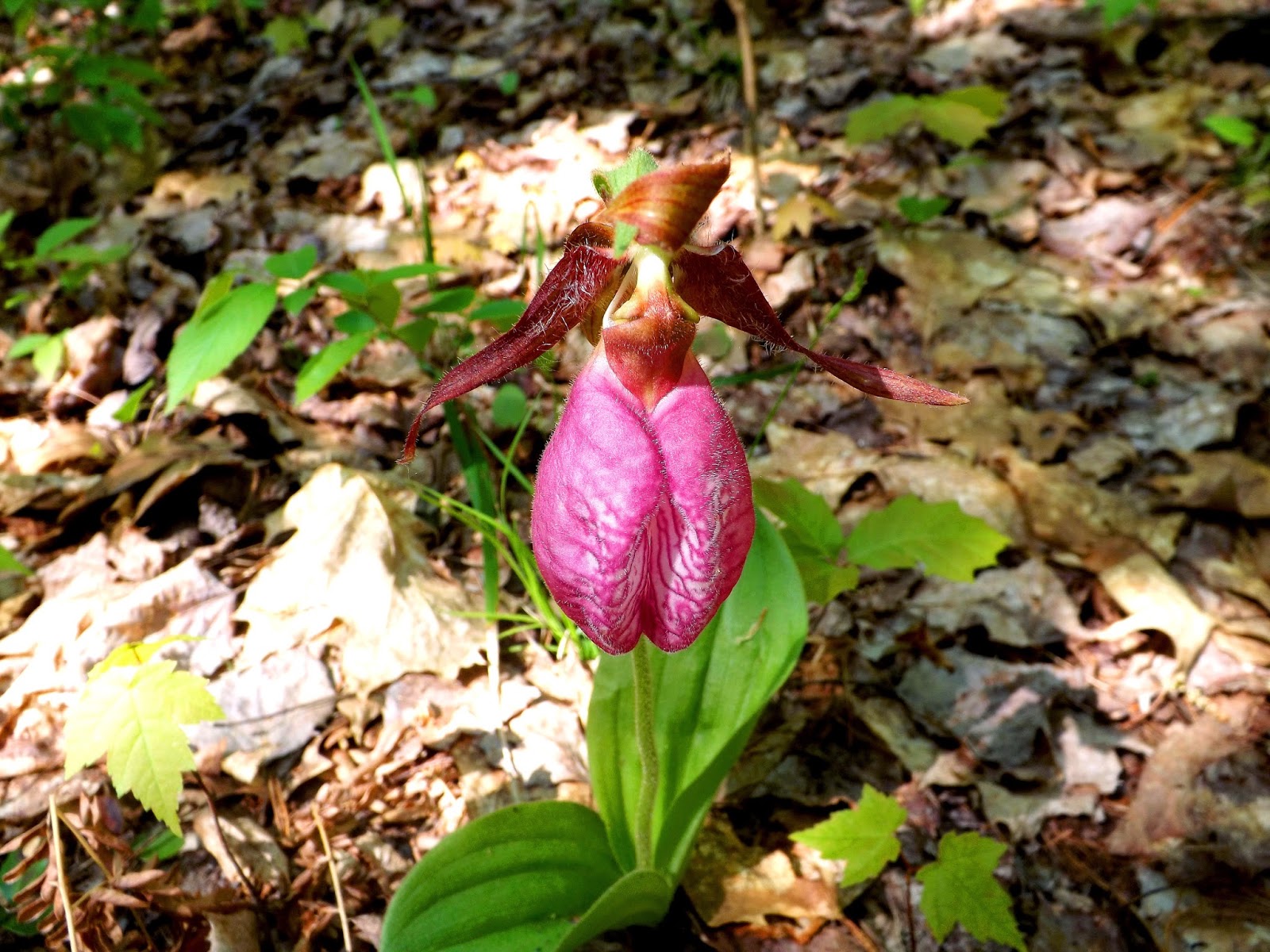
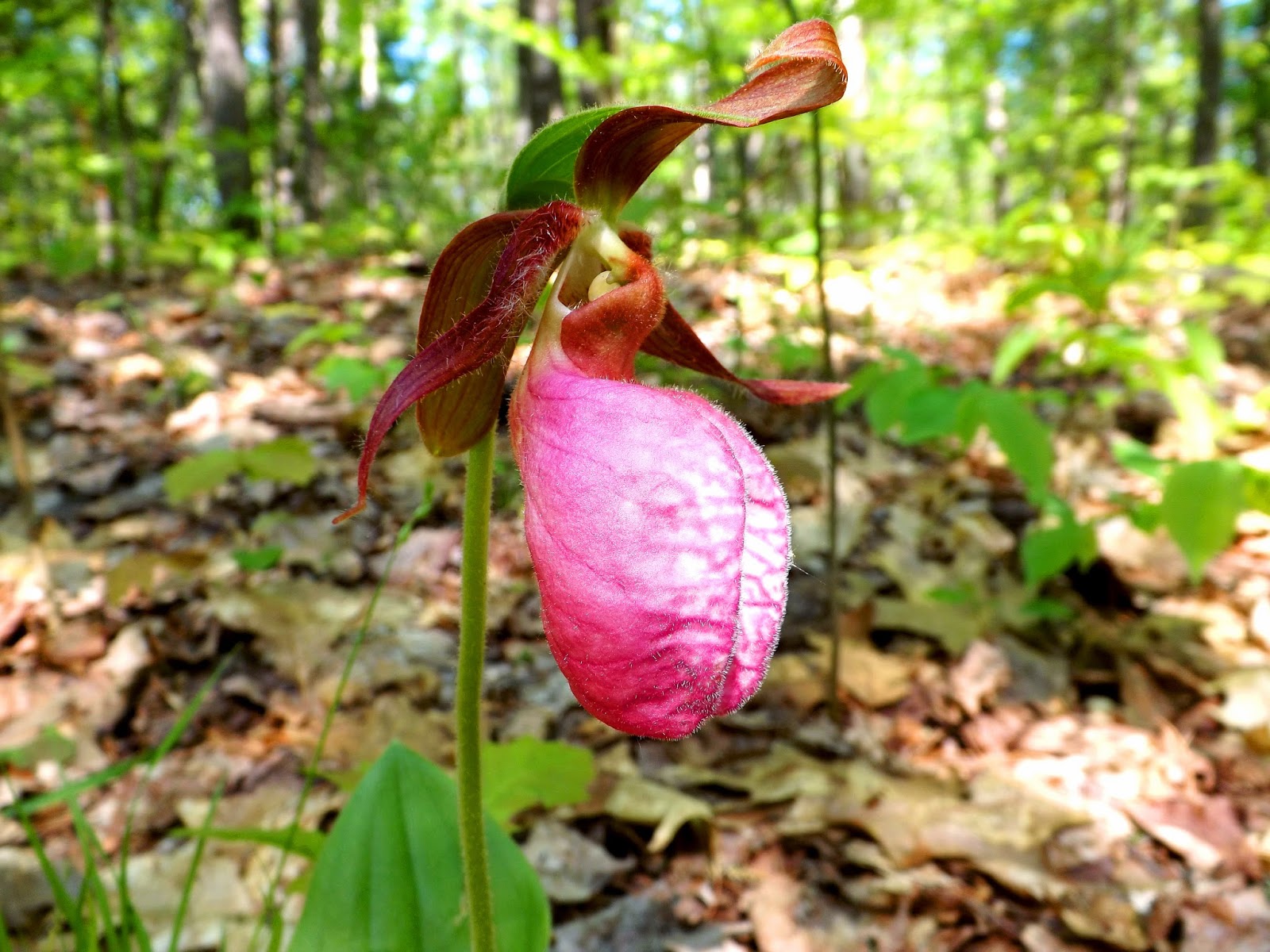
The Orchidaceae (orchid family) have started to bloom now. My father and brother have reported that the Cypripedium arietinum (ram's head orchid) and the Cypripedium parviflorum (yellow ladyslipper) are both blooming now on my parents' property in the upper Gatineau. I wrote a blog post about those species last year. This year, my father and brother also reported something special.
While wandering around, they found another orchid, this one quite unusual for the area: the pink ladyslipper (pink lady's slipper, moccasin flower). The species is relatively abundant in Canada but occurs more in pine forests rather than deciduous (or mixed deciduous like is found on my parents' property). They were kind enough to send me photographs so that I could write a blog post about them, so today's photos were taken by guest photographers!
Cypripedium acaule with leaves - note the paired basal leaves and the lack of leaves on the stalk
This lovely flower is native to eastern North America (NA range map here; Canadian range map here). Unfortunately this plant is endangered in Tennessee (also commercially exploited in this state) and Illinois, exploitably vulnerable in New York, and unusual in Georgia [1]. In Canada it is doing better, listed as secure for the country as a whole and in most of its range; it is sensitive in Alberta, and has an undetermined status in the Northwest Territories [2].
Cypripedium acaule front view
So why do I call this pretty flower a jerk? Well, this is a 'deceptive' flower. Specifically, this is a food-deceptive flower. This species (along with both C. parviflorum [3] and C. arietinum [4]) has a strong fragrance which it uses to attract pollinators who associate the fragrance with nectar rewards -- but the plant doesn't produce any nectar at all, so the pollinator gains no benefit for its visit [5]. One might wonder why a plant would evolve such a system, of course; these plants are pollinated much less frequently than reward-offering plants [6,7,8], and not producing nectar would not necessarily constitute a particularly large energy savings [8]. The question of why deception is such a common strategy in orchids is an interesting one for researchers as a consequence. A number of theories have been proposed, some of which are discussed here for those interested.
Cypripedium acaule side view
One of the natural consequences of the plant's deception is that it depends on naive bees (bees that haven't visited it much before) for pollination, because they learn after a few tries that the flower doesn't have any reward and stop visiting [5,6]. So, there are few fruit produced each year (few successfully pollinated flowers) [5].
Cypripedium acaule front view - close - note the fine hairs (trichomes) on the petals and sepals
There is another interesting aspect of this (and other orchids') reproductive ecology that I will discuss in conjunction with some other flowers later this week, so those who are aware of the interesting thing I am skipping over -- I know, I'm just saving it for another post.
Cypripedium acaule bottom view
Many of these orchids are rare, and tend to do very poorly when transplanted in gardens. One of the major reasons for this is that many orchids are reliant on a particular type of fungus in order to germinate seeds [5,6], so they can't reproduce outside of areas where the fungus is present; so, when gardeners dig the flowers up and bring them to their gardens, the plants will not survive or reproduce effectively [6]. Thus, if you find these species in the wild please do not give in to the temptation to take the flowers. They won't survive and you will damage the population's genetic diversity. In fact, it is illegal to remove the pink ladyslipper in Georgia (poaching) [6], as this is becoming a serious threat to a variety of orchid populations. This caution applies to most wild orchids including the yellow ladyslipper and the ram's head orchid.
Many thanks to my guest photographers for the gorgeous shots!