Showing posts with label orchidaceae. Show all posts

Monday, April 24, 2017

A new field season begins!

I have been working away at my stats, analysis, and writing in the lab since my last post in September about the transition between fieldwork and data analysis. With the melting of the snow, I'm now heading back out into the summer portion of the ecology research cycle: field research!

I will be collaborating with my labmate Cory and his old supervisor on long-term research with the population of Cypripedium arietinum (ram's head orchid) at the lake; I've written about this plant before -- there's a nice photo of the flower over on that post as well so go check it out!

Orchids are interesting for lots of reasons. Here are just a few:

(1) Many orchids are unrewarding, which means that they don't offer nectar to pollinators in exchange for pollen transport. With unrewarding orchids we can investigate questions about the evolutionary consequences and/or adaptive mechanisms for deceiving pollinators into moving pollen from plant to plant

(2) Many orchids are spring ephemerals. This means that they flower in the brief window in the spring after the snow melts and before the trees put out their leaves. Synchronizing with their pollinators, which are just waking up from their winter hibernation, is particularly important for them to successfully reproduce. With these plants, then, we have opportunities to investigate how small- and large-scale variation in climatic conditions (e.g. timing of first snow melt, date of tree leaf bud bursting, quantity of canopy that's open throughout the blooming period, variation in temperatures, etc) can affect the emergence synchronization of flowers and their pollinator.

(3) Orchids rely on fungi in the soil in order to germinate and grow, so we can ask questions about how such a system might evolve and how the orchids and fungi can affect each other over time and space.

Cory and I went out yesterday to get some basic information about the areas where the plants are found, so that we can get a sense of what kind of designs are going to work best.

At the start of the season we're often just exploring a bit, to get a sense of what we have to work with with respect to terrain and space. This kind of knowledge is invaluable for designing studies and making decisions about what kinds of tools and techniques we want to use.

We were delighted to notice that we could pinpoint a few clumps of the plants because we found some old fruiting stalks (seed pods on old stalks) that survived over the winter. They aren't easy to spot because they're small and about the same colour as dead leaves and twigs on the ground, but with a bit of crawling around and some prior knowledge, they can be found.

These old seed pods are great not just to help us locate plants, but also because they allow us to glean a bit of information about last year, too; a rough count of how many old seed pods there were this spring gives us a minimum number of seed pods that were produced last year (we can't know what proportion were lost over the winter, so we can't say how many more than this count were produced).

Old seed pod of C. arietinum
Because these orchids are perennials, finding these old stalks allowed us to locate at least some of the clumps of C. arietinum at our sites. What's more, we even found some very young shoots already coming up!

In the centre of this photo (look closely) there are several little C. arietinum shoots just starting to come up; the white thing is a tag that we put in to mark the location of this clump

Cory and I put in some temporary tags and some flags to mark off the general areas where we know there are plants; this will make our work easier next week when we go back next weekend to install permanent tags for the clumps of C. arietinum, since we're going to want to be able to track them across years.

Cory, next to a pole that he placed to mark one of the areas of the property where we found some C. arietinum clumps
At that point, we'll also start making a GPS map of the coordinates of our populations and clumps for good long-term data maintenance, and as insurance against long-term markers being lost or displaced accidentally.

My husband was recruited as an unpaid but dearly appreciated field assistant; here we are counting old stalks, fruit, and new shoots in a clump of C. arietinum that he found.
We'll be going back throughout the season to track these plants as they grow, bloom, and fruit. I will post some more updates as the season progresses.

Purely out of curiosity, we spent a bit of time fiddling with the old seed pods; we noticed that most of them had opened and dispersed all their seeds, already, but that some still contained seeds and were in varying stages of openness. Those that were partially open were interesting because when shaken or nudged, they sent out clouds of thousands of miniscule seeds! We took a video that is unfortunately out of focus, but you can see the seeds as little blurry pale things in the video clip below:


We also collected a couple of old seed pods from last year that hadn't opened and released all their seeds and spent a few minutes today looking at the seeds under the microscope out of curiosity. We weren't using the fancy Zeiss research scope in the lab upstairs, so there's no camera mount on this microscope and it's not the most amazing scope ever, but I can at least give an idea of what the seeds look like:

C. arietinum seeds; the dark spot in the centre is the seed itself. The old cell walls are visible in this image as dark lines that seem to be outlining somewhat rectangular shapes. This image is at taken at 100X magnification, so the entire structure including coat is maybe 1mm long or a bit less, while the seed is less than that. Tiny!
I am absolutely delighted that the field season has started up again. This is just one of a few projects I'm hoping to work on this year. I will make sure to post a bit more this year than last about what I'm up to and why over the field season.

Monday, May 25, 2015

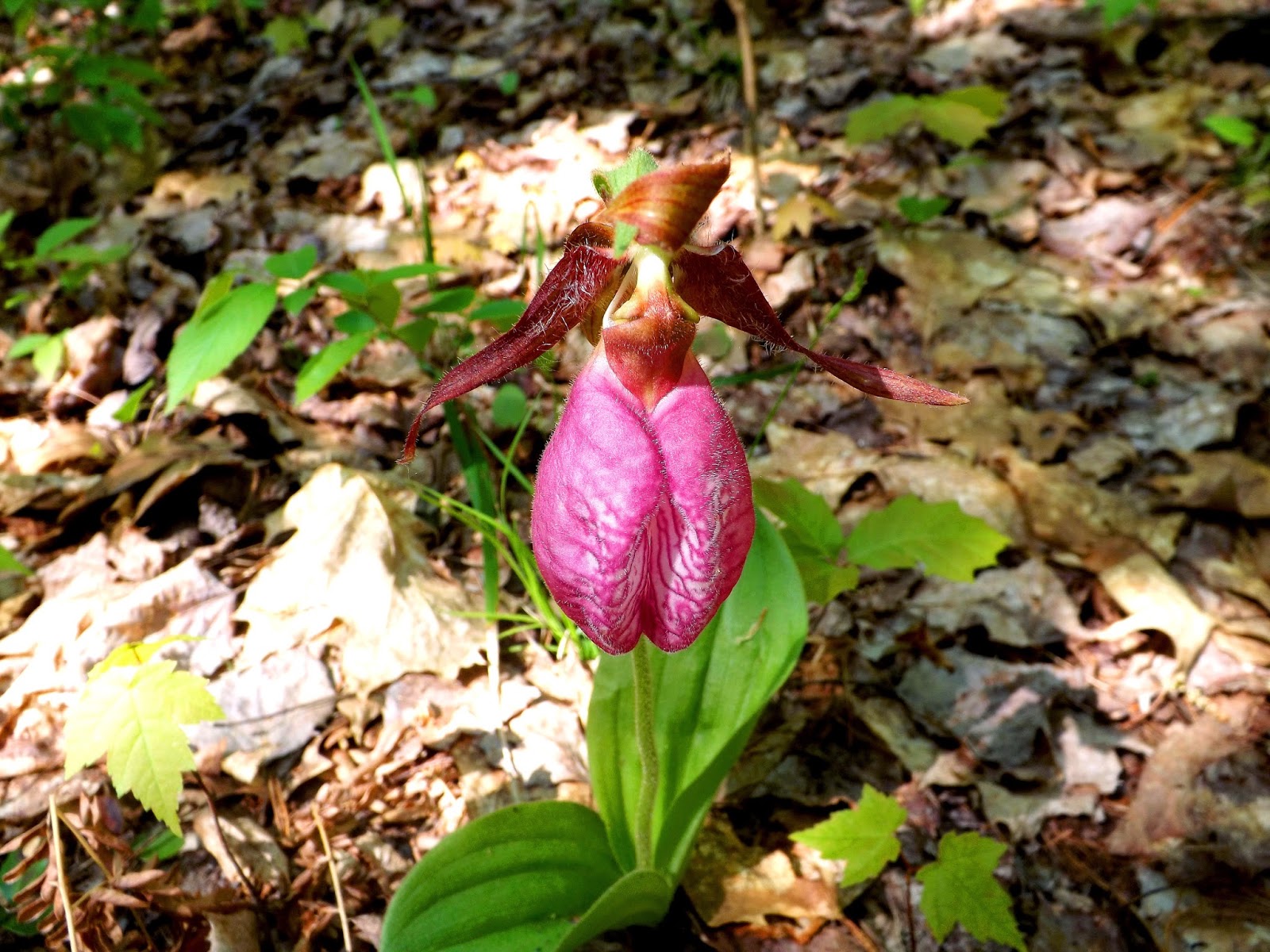
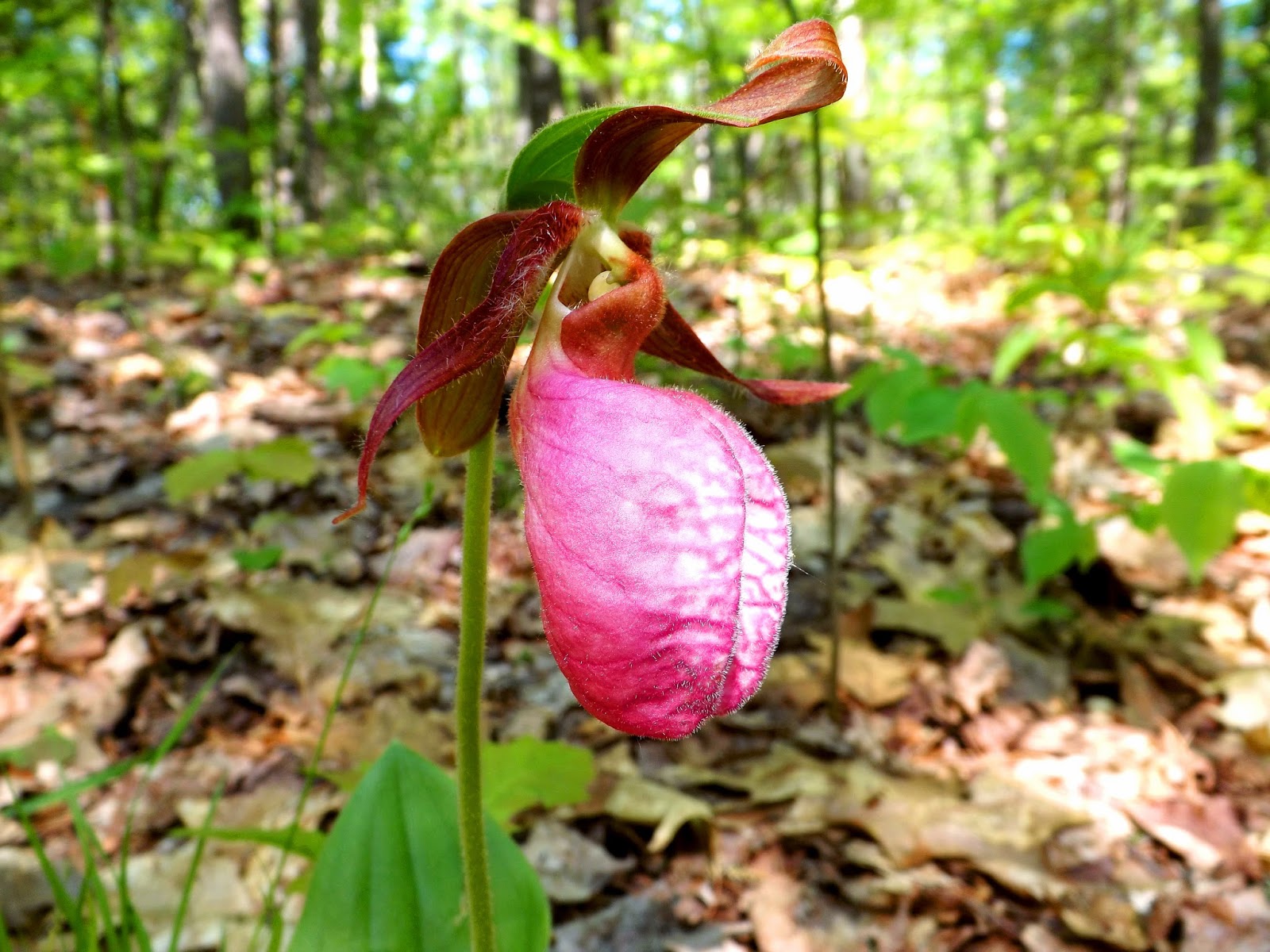
Sometimes Flowers are Jerks Part 1: Pink Ladyslipper - Cypripedium acaule - Sabot de la vierge

The Orchidaceae (orchid family) have started to bloom now. My father and brother have reported that the Cypripedium arietinum (ram's head orchid) and the Cypripedium parviflorum (yellow ladyslipper) are both blooming now on my parents' property in the upper Gatineau. I wrote a blog post about those species last year. This year, my father and brother also reported something special.

While wandering around, they found another orchid, this one quite unusual for the area: the pink ladyslipper (pink lady's slipper, moccasin flower). The species is relatively abundant in Canada but occurs more in pine forests rather than deciduous (or mixed deciduous like is found on my parents' property). They were kind enough to send me photographs so that I could write a blog post about them, so today's photos were taken by guest photographers!

Cypripedium acaule with leaves - note the paired basal leaves and the lack of leaves on the stalk
This lovely flower is native to eastern North America (NA range map here; Canadian range map here). Unfortunately this plant is endangered in Tennessee (also commercially exploited in this state) and Illinois, exploitably vulnerable in New York, and unusual in Georgia [1]. In Canada it is doing better, listed as secure for the country as a whole and in most of its range; it is sensitive in Alberta, and has an undetermined status in the Northwest Territories [2].

Cypripedium acaule front view
So why do I call this pretty flower a jerk? Well, this is a 'deceptive' flower. Specifically, this is a food-deceptive flower. This species (along with both C. parviflorum [3] and C. arietinum [4]) has a strong fragrance which it uses to attract pollinators who associate the fragrance with nectar rewards -- but the plant doesn't produce any nectar at all, so the pollinator gains no benefit for its visit [5]. One might wonder why a plant would evolve such a system, of course; these plants are pollinated much less frequently than reward-offering plants [6,7,8], and not producing nectar would not necessarily constitute a particularly large energy savings [8]. The question of why deception is such a common strategy in orchids is an interesting one for researchers as a consequence. A number of theories have been proposed, some of which are discussed here for those interested.

Cypripedium acaule side view
One of the natural consequences of the plant's deception is that it depends on naive bees (bees that haven't visited it much before) for pollination, because they learn after a few tries that the flower doesn't have any reward and stop visiting [5,6]. So, there are few fruit produced each year (few successfully pollinated flowers) [5].

Cypripedium acaule front view - close - note the fine hairs (trichomes) on the petals and sepals
There is another interesting aspect of this (and other orchids') reproductive ecology that I will discuss in conjunction with some other flowers later this week, so those who are aware of the interesting thing I am skipping over -- I know, I'm just saving it for another post.

Cypripedium acaule bottom view
Many of these orchids are rare, and tend to do very poorly when transplanted in gardens. One of the major reasons for this is that many orchids are reliant on a particular type of fungus in order to germinate seeds [5,6], so they can't reproduce outside of areas where the fungus is present; so, when gardeners dig the flowers up and bring them to their gardens, the plants will not survive or reproduce effectively [6]. Thus, if you find these species in the wild please do not give in to the temptation to take the flowers. They won't survive and you will damage the population's genetic diversity. In fact, it is illegal to remove the pink ladyslipper in Georgia (poaching) [6], as this is becoming a serious threat to a variety of orchid populations. This caution applies to most wild orchids including the yellow ladyslipper and the ram's head orchid.

Many thanks to my guest photographers for the gorgeous shots!

Monday, May 26, 2014

Orchidaceae - Cypripedium spp. - Orchids - Orchidées

I photographed two species of orchid at the lake this weekend. Both are native to the area; one is rather common and the other exceedingly rare.

The more common species is Cypripedium parviflorum var. pubescens (large yellow lady's slipper, fr: Sabot de la vierge). It is an extremely distinctive flower of the family Orchidaceae; its conservation status is not listed in Canada (species profile at Plants of Canada database) as far as I can tell, but it is listed in the US as threatened or endangered in several states (USDA species profile). Other sources, bafflingly enough, list this flower as abundant in Canada. As it stands I'll stick with the information provided by official sources and assume that C. parviflorum var pubescens is either not at risk in Canada or unresearched here.

My (purely anecdotal, entirely biased, completely unreliable) personal observational sense would suggest that this species is not particularly rare at least in Gatineau, as it appears to be relatively abundant. Mind you, I'm talking about a relatively small plot of land which is unusually well-protected, so perhaps my perception is skewed by their relative commonness in the area where I usually spend my outdoors time. In any case, I counted 61 individuals in a 15"x10" plot just by the driveway of the house this weekend, including one clearly mutated individual which had two flowers on the same stalk (this species is supposed to have a single stalk with a single flower at the top). There are a number of populations scattered around the property, most of them as large or larger than the one we surveyed.

It is quite a charming flower and remarkably fragrant, a characteristic quite common in the Orchidaceae. It also displays the Orchidaceae apomorphies of bilateral symmetry and heavily modified petals.

Stand of C. parviflorum var. pubescens

C. parviflorum var. pubescens flower in front view
This front view of the C. parviflorum var. pubescens flower shows nicely the bilateral symmetry characteristic of the family. I've always been quite charmed by the way the sepals curl in this flower.

C. parviflorum var. pubescens lateral view
This image shows a bit more clearly the heavy modification of the three petals. The large, bulbous portion of the flower is one petal; the other two are curled together at the centre of the flower over the opening in the first.

The other species I photographed at the lake is a bit more unusual. Cypripedium arietinum (ram's head orchid, fr: cypripède tête de bélier) is rare and listed as a species at risk in Quebec. It is also listed as threatened or endangered in the US. The colony on the property seems to be relatively prosperous for the moment; last year we counted about 200 individuals along about 500"x30" (they are distributed roughly in a strip near the shore of the lake); this year we counted 132 individuals and saw evidence of deer predation on the orchids (clipped/bitten plants). We are considering putting protective cages around some of the more accessible plants to see if we can't cut down on deer predation for this vulnerable population.

This species also displays the interesting apomophies of the family listed above.

C. arietinum
I think this is a fairly nice specimen photo of this flower. I'm pleased with the way it came out. I've also always loved the spiderweb-like patterns on this orchid. It is much smaller than the Large Yellow Lady's Slipper and considerably harder to spot in the woods. It takes a fair bit of effort to locate individuals among the brush; they are shorter, the flowers are smaller, and the flower profile is much more subtle from above (the upper sepal overhangs the flower, hiding it from view and having a tendency to make the plant look a whole lot like just another Streptopus amplexifolius or Maienthemum racemosum.

C. arietinum