So I suppose it's about time I talked about the garden a bit. This year, E and I are trying something new. Back in a post on July 5, 2012 (
Pollination Station), I illustrated my method for ensuring pollination of some of the plants for which pollination is necessary for production. It involved running around with a brush, a decidedly inefficient and inelegant state of affairs. The garden I maintain is on three levels: ground level, second floor, and third floor. Pollinators are unfortunately quite rare on the third floor, presumably because bees well-laden with nectar and pollen don't have any interest in flying up two stories to look for more.
So this year we're trying something new. E is doing some bee research at a lab at the university, under the supervision of a researcher who has been invaluable in her assistance to get us started. Basically, we're raising a bumblebee colony. Bad. Ass.
... The process is surprisingly sensitive. We ran around with nets and pill bottles early in the season, capturing bumblebees (
bombus impatiens), because early in the spring all the bumblebees are queens; the queen comes out of hibernation and flies around collecting pollen and nectar and looking for a suitable nest site, then eventually starts laying eggs. Actually, there's a rather low success rate for
b. impatiens colonies, so it was necessary to capture multiple queens in hopes that one would reproduce, so I should say that only
some of them eventually start laying eggs.
So. We caught some bees. Watched and waited. Finally, one of them
appears to be incubating eggs. The rest have been released, and Gardenia
(that's the name we gave the successful queen) has been moved outside
and we've opened up the incubator for her in case she wants to forage.
We've supplied her with nectar and pollen, as well as cotton to use in
forming the initial nest, so she doesn't actually have to leave.
Eventually her workers will leave the hive to forage. And then they will
pollinate our garden goodies and I won't have to run around with a
paintbrush anymore.
 |
| Peeking into the nest |
You'll notice right away while looking at the above shot that
b. impatiens doesn't make the organized honeycomb that people generally expect when thinking of bees.
 |
| The incubator |
|
This is the exterior of the incubator. The closer portion is where the nest is; the further portion is where we're putting a capful of nectar for Gardenia, which prevents the need for her to venture outside in order to support the colony (the pollen we've provided her with is visible in the photo of the nest).
 |
| Location of the incubator |
We've tucked the incubator into a quiet corner of the deck for now, with the exit facing directly into the planters where I've put some of the flowers I planted this year in order to supply the colony. We are anticipating the possibility that we'll have to provide them with nectar or pollen as the season wears on, but we'll be monitoring the colony closely.
We'll be moving the nest into its proper box soon so that the hive has the chance to grow and spread.
But of course, social bees aren't the only bees who pollinate the
garden. Far from it; solitary bees (bees who do not form colonies, but
rather forage & reproduce individually) are extremely common and
also very important for pollination. Fortunately, keeping solitary bees
is considerably less time-consuming and difficult than trying to
establish a colony. Solitary bees just need to be provided with a
suitable nest site, and they'll move right on in!
This is where my dad kicks ass. I was doing some research on solitary
bees (I'm less familiar with them), and found out exactly how to set up
for solitary bees. My father, once I explained the process to him,
pulled out his drill bits and got some wood and helped me set up some
solitary bee space.
I'm not really expecting to get any solitary bees this year (it's a
little late for nesting), but at the very least we should get some next
year. Since we have an apple tree in the back yard, that's to the good.
 |
| Close-up of part of the bee house |
|
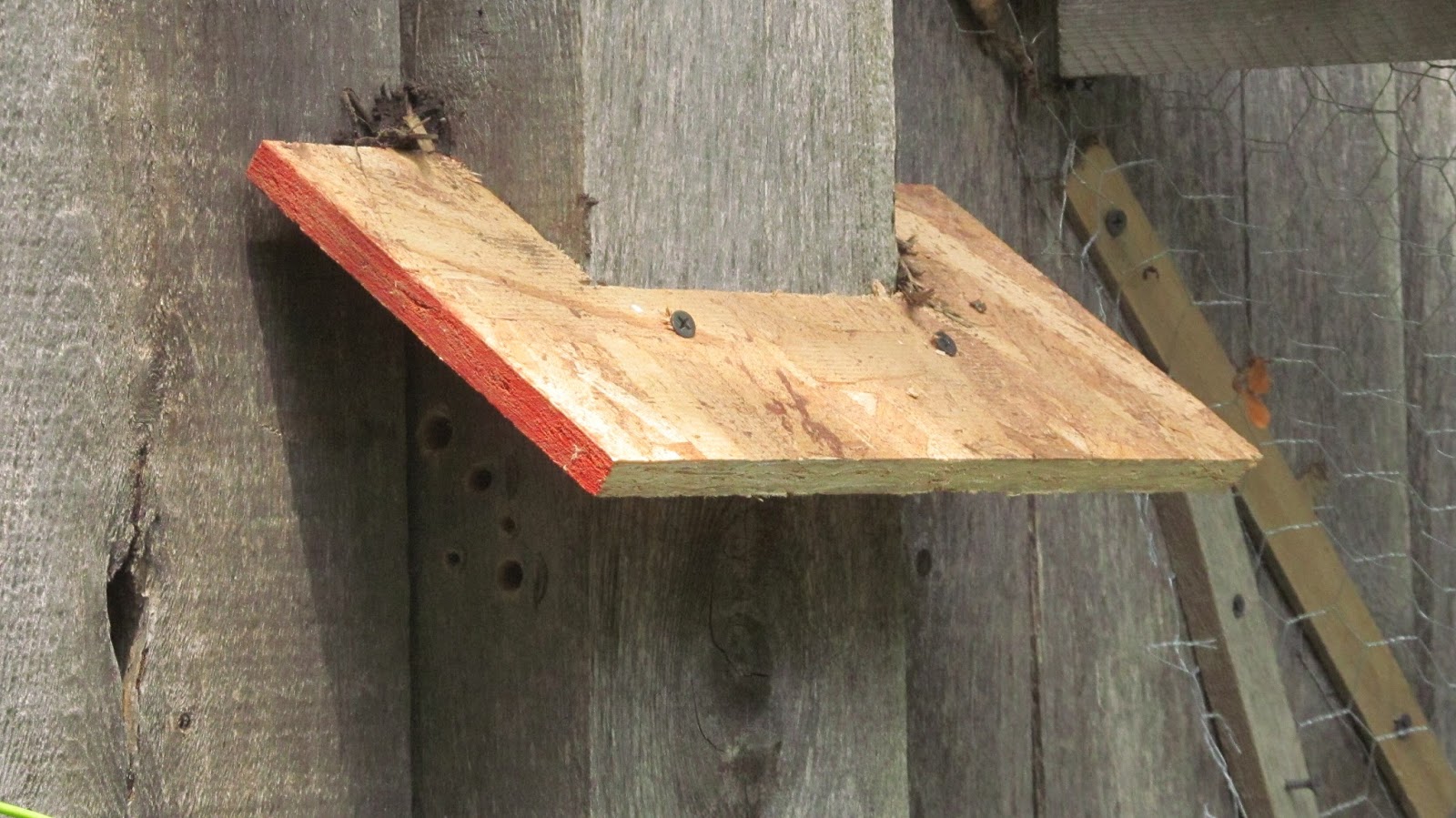
Solitary bees are of varying sizes, so need tunnels of varying sizes to accommodate them. My dad drilled some holes of varying sizes on two sides of two of our fenceposts (total of four sides drilled). Solitary bees look for tunnels of the right size to nest in; holes in wood are appealing enough, so that's what we've put up here.
 |
| One of the bee houses from a distance |
My dad then sheltered the bee houses, to keep the rain out (wetness prevents the bees from prospering).
So there we have it. My dad rocks. So do bees.
Of course, this blog just wouldn't be what I've always envisioned it to be if I didn't take a moment to also share a photo of something I thought was particularly beautiful today. Enjoy.
.JPG) |
| Browallia speciosa |
 |
| Calibrachoa |