Showing posts with label invasive species. Show all posts

Thursday, August 6, 2015

The Root of Invasives: Burdock - Arctium lappa - Bardane

One visually arresting plant that you will be more likely to find in disturbed environments (eg parks, cities, agricultural areas, roadsides) is burdock. This plant is an introduced invasive plant originally native to Europe and Asia [1], and has been introduced, likely as a garden plant.

Arctium lappa whole plant view
Arctium lappa (greater burdock) is a particularly striking plant, rising to an impressive top height of 2.7m or even 3m [1,2]; its lower leaves can grow to enormous sizes, and its large purple flowerheads on tall stalks make the plant almost impossible to miss.

Arctium lappa inflorescence
A. lappa is broadly distributed in the US and Canada (US range map here, Canada range map here). Though introduced, it has no special status in the US [3], but is listed as a noxious weed in several provinces [4], including Alberta [5], British Columbia [6], and Manitoba [7]. This is likely because it can spread very aggressively in nitrogen-rich soils (eg agricultural areas) [1], because it can cause skin irritation and rash on contact [8], and the fine hairs on the seeds can be dangerous if inhaled [8], and because there is some evidence that the plant may be toxic to some mammals [9].

Arctium lappa inflorescence
This plant is very well known for its edible root. The root of A. lappa used to be fairly commonly consumed by humans from Europe to Asia but currently is only common in Asian cooking (especially Japanese) [1]. The root is edible, best harvested in the fall of the first year of growth (burdock is biennial) [1]. It is mild and crisp. The young leaves and shoots are also edible, generally cooked as a pot herb or in salads [1,10].

A. lappa is a frequent staple of traditional Chinese medicine [1], but there is currently insufficient evidence for its use to treat a broad assortment of ailments [11]. Its use is specifically contraindicated for diabetics and pregnant women [10].

Arctium lappa inflorescence covered with bees
A. lappa seems to be quite popular with Bombus spp (various bumblebee species), as it was actually a challenge to get photos of it without bees.

Sunday, June 28, 2015

Oxeye Daisy - Leucanthemum vulgare - Margueritte

This is perhaps one of the most-recognized flowers around (though there are quite a lot of flowers that go by the common name 'daisy'). Leucanthemum vulgare is native to Europe & Asia [1,2,3] and was introduced to North America in the 1800s as an ornamental plant [2,3]. I have very briefly posted about this plant before.

Leucanthemum vulgare inflorescence
Since its introduction, Leucanthemum vulgare has spread over most of North America (US range map here, Canada range map here). Although it is pretty, this species is listed as an invasive species in the US [4], and classified as a noxious weed both federally and in most provinces where it is found in Canada [5]. In Canada, the noxious weed classification indicates that the plant is invasive and disruptive of native plants and ecosystems on a large scale. I do not recommend this plant to gardeners.

Clump of Leucanthemum vulgare
Some parts of this plant are edible [3,6]; I have eaten the young leaves before and they are rather spicy/carroty.

Leucanthemum vulgare inflorescence
This species is pollinated by bees, flies, beetles, wasps, and butterflies [2].

Friday, June 26, 2015

Crownvetch - Securigera varia - Coronille variée

Today we have yet another introduced species in the family Fabaceae (legume family), this time introduced not as a fodder crop or an ornamental, but for ecosystem management: Securigera varia (aka Coronilla varia, crownvetch) has been introduced to North America primarily as an erosion control plant [1,2,3,4,5,6]. Securigera varia is suitable for this purpose because it spreads rapidly (both through seeding and through vegetative propagation by root spreading) and forms a dense root system [1,2,3,5]. Like many members of the Fabaceae, Securigera varia is a nitrogen-fixing plant [2,4,5,6].

Securigera varia inflorescence
Since its introduction to North America in the 1950s, Securigera varia has spread across much of the continent (US range map here, Canada range map here). Unfortunately, those traits which make Securigera varia a suitable erosion control plant can also make it a problematic invasive plant [1,2,3,5,6]. This plant will tend to squeeze out other plants, disrupting ecosystem functioning [1,2,3,4,5,6].

Securigera varia foliage resembles that of Vicia cracca (cow vetch):

Securigera varia foliage

Wednesday, June 3, 2015

Introduced Species: Greater Celandine - Chelidonium majus - Grande éclaire

At the moment if you take a walk into the wooded portion of the Notre-Dame-des-Neiges Cemetery, you will see an abundantly growing, attractive yellow flower in much of the forest understory.

You might be tempted to conclude that it is the native Stylophorum diphyllum (wood poppy), which has similar leaves and flower. You would unfortunately be incorrect. This is actually the introduced species Chelidonium majus (greater celandine), which resembles Stylophorum diphyllum primarily because they are both members of the family Papaveraceae (poppy family). The native variety, however, has much larger flowers, its leaves are more deeply incurved, and its seed pods are round and hairy rather than the long and slender ones we see in this species.


Chelidonium majus population in bloom
This species is a member of the Papaveraceae (poppy family), so produces the latex-filled sap that is characteristic of this family. Given that, if you're sensitive to such things I would not recommend walking through a population of these in shorts.

Chelidonium majus
So if it's introduced, where is it originally from? Well, this species is native, as many of our introduce species, to Europe [1]. It is now distributed quite broadly across the US (range map here) and Canada (range map here). This species is considered invasive in some parts of the US [2] and is notably good at spreading and naturalizing [3].

Chelidonium majus seed pods
If you are having difficulty determining whether the plant you're looking at is Chelidonium majus or Stylophorum diphyllum, just look for the seed pods, which are very different in the two species. Above I have included a photo of the elongated seed pod of Chelidonium majus.


So why was it introduced here? This plant was originally brought over for medicinal purposes, used for a whole range of illnesses and problems including stomach ailments, warts, and menstrual problems [4]. Note, however, that there is not much evidence for its use in these capacities: it is possibly effective (some limited evidence) for stomach upset, and there is insufficient evidence for the remaining claims [4].

Wednesday, May 27, 2015

Kill it With Fire, and Other Methods of Invasive Species Management : Garlic Mustard - Alliaria petiolata - Herbe à ail

Though you may not have thought much about it, I can guarantee that you've encountered this extremely invasive species. Alliaria petiolata (garlic mustard) is native to Europe and was introduced in North America as a flavouring herb [1]. Since its introduction, this plant has spread broadly, and, because of some of its growth and reproductive characteristics, poses a serious threat to the biodiversity of forest understory habitats [2].

Alliaria petiolata in a park in Montreal
A North American range map for the introduced species can be found here. The plant is listed as invasive, prohibited, prohibited invasive, prohibited noxious, banned, and Class A or B invasive in various parts of the US [3]. The plant is prohibited in Alberta and Saskatchewan [4]. It is a member of the Brassicaceae (mustard family) and is biennial; the first year, it produces a basal rosette of leaves, and the second, a flowering stalk [2].

So what's the big deal with this plant?

Well, it's a collection of things. This introduced plant has none of the natural predators here that are present in its native range [5], so unlike in its native range it spreads here essentially unchecked. It is known to damage native plant and tree populations [5,6]. There is some evidence that it inhibits the growth of other plants around it, as well [5,6]. This plant is also very difficult to control, as it produces large amounts of seed, is a perennial, and prospers in disturbed areas [5].

Dense population of Alliaria petiolata
What do we do about these kinds of plants? Well, it depends a lot on the particular environments in which we are trying to control the species, and on the species and its life cycles and reproductive ecology. In the case of A. petiolata, for example, pulling is a poor method of control which can actually make the situation worse, as the plant thrives in disturbed habitats and pulling creates lots of disturbed soil [5]. With other plants, pulling might be a better solution.

Flowers and seed pods of Alliaria petiolata
Burning has been attempted as well, but unfortunately not very successfully; when the fire doesn't get every last seed, the burning produces a habitat that is very favourable to the spread and reestablishment of the population [6]. Chemical control is similarly patchily effective at best.

Simply clipping the plant back also isn't enough; if it's clipped back before it has produced flowers, it'll just keep on coming back [5]. But, cutting after the flowers have started but before the seeds have set is an effective strategy if repeated over time, especially if the plants are cut as low as possible (ground level) [5,6] -- but note that the clipped parts must be removed and properly disposed of or they can still set the seed - the Nature Conservancy of Canada recommends cutting the plant repeatedly from top to bottom [5]. A the population level, it is recommended to clip the smaller spreading populations first and then work on controlling the source populations [5].

Basically if you're in North America and you've got this plant somewhere, be ruthless. Wait until it flowers, then cut it up from top to bottom. Then do it again in the next years until the thing stops coming back up.

Wednesday, May 13, 2015

Norway Maple - Acer platanoides - Érable plane

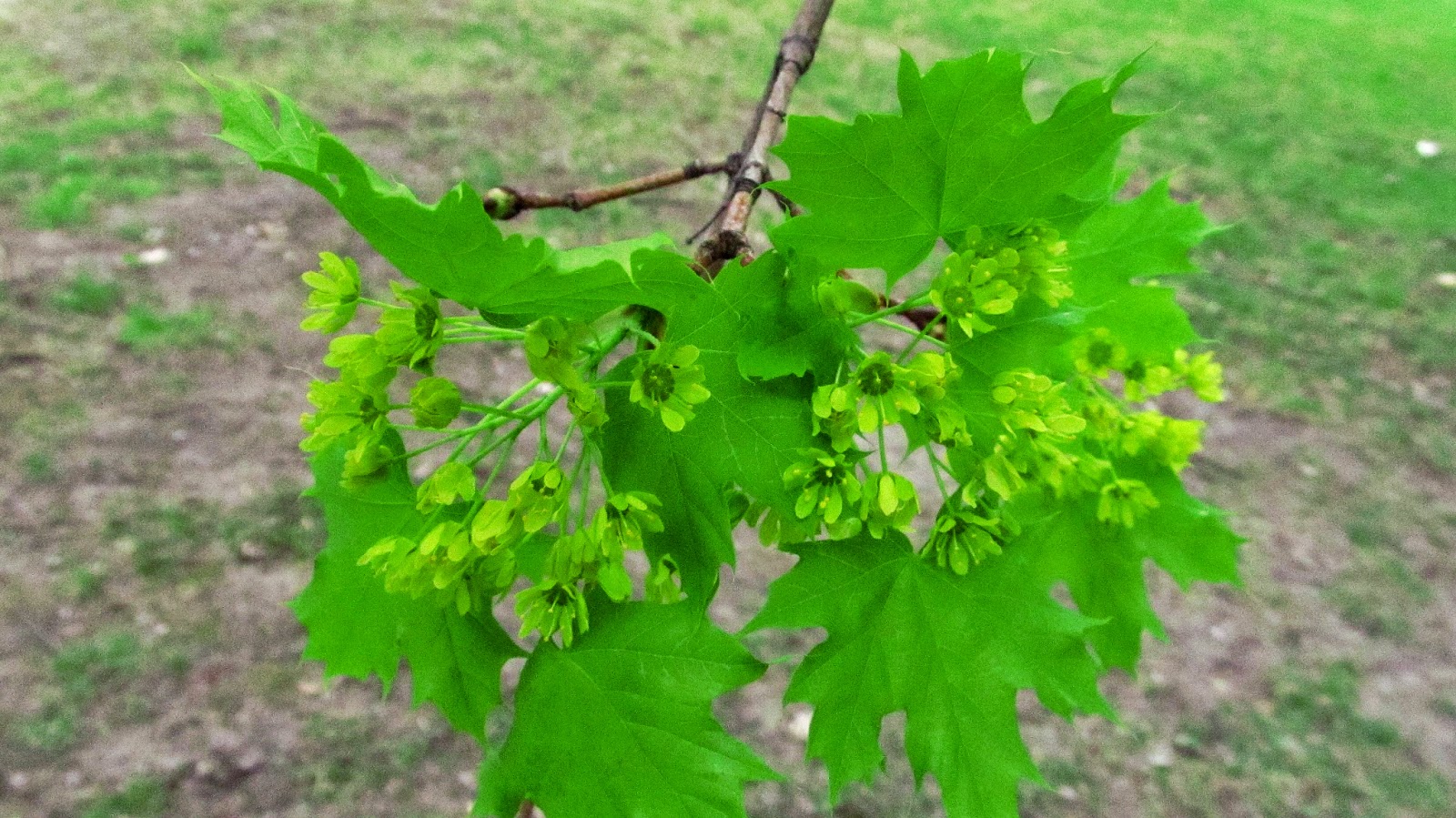
This maple has been blooming vigorously in Montreal for a little over a week now, no surprise as it is an early bloomer.

A. platanoides
Though it looks similar to the native Acer saccharum (sugar maple), this species is an introduced ornamental which is extremely popular in cities for its tolerance to a wide variety of environmental conditions [1]. The species is native to eastern and central Europe [2], but is naturalized in parts of North America particularly the northeastern US [1,3]. Exact distribution maps for this species are unfortunately not available at present; due to its popularity as an ornamental and its potential to spread into wild habitats as a result of its introduction in lanscaped areas, it is not presently known exactly how widely distributed the species is [4]. At any rate, it is classed as an invasive species in the US [1,2,3,4] and Canada [1,2,4]

A. platanoides flowers
A. platanoides ornamental varieties with red leaves such as the popular Crimson King cultivar [5] have been bred as well and are very popular.

A. platanoidies, cultivar Crimson King
This species' invasiveness is cause for some concern, particularly as it inhibits understory plants beneath it [1,3,4] and could not only crowd out native maple species such as the economically important A. saccharum (sugar maple, the source of maple syrup), but also other native trees such as beech [1,3,4]. There is the possibility that an observed reduction in understory diversity below A. platanoides could also result in loss of understory herbs and shrubs, but at present there isn't any data to back the idea up [4].

A. platanoides, cultivar Crimson King : flowers
This is an animal-pollinated species[1,4], visited by Bombus spp. and Andrena spp. [1]. That it is animal-pollinated rather than wind-pollinated shows in the structure of its flowers. Note the presence of sepals, petals, stamens, and pistils -- these are 'perfect' or 'complete' flowers, bearing all of the basic characteristics of a standard animal-pollinated flower (note that they are also monoecious, as indicated by the presence of both male -- stamen -- and female -- pistil -- parts on the same flower and tree) :

Complete flowers on A. platanoides - note that though the pistil is small, it is present
The pistil is a bit more visible in the flowers of the cultivar Crimson King. It's the red part in the centre:

Complete flower on A. platanoides, cultivar Crimson King
The simplest method for an amateur to distinguish between A. platanoides and A. saccharum is to break one of the leaves from the stem and squeeze a bit; if the sap is clear, it's A. saccharum, whereas if the sap is milky, it's A. platanoides [1,3,5].

Tuesday, April 28, 2015

Is Scilla siberica invasive?

I've noticed the crocuses, daffodils, and even some early tulips blooming in the neighbourhood gardens this week. But the most eye-catching flower out right now is Scilla siberica (siberian squill).

S. siberica
Scilla siberica is an introduced species, native to Russia, which was introduced here as an ornamental plant. It is attractive and easy to cultivate, as it spreads widely with very little encouragement or care needed. This species is a member of the Asparagaceae (asparagus family).

A friend of mine asked me a question this week that has no easy answer: Is S. siberica an invasive species? There are now some places in the United States where S. siberica is certainly listed as an invasive species [1], though there also appears to be some debate about this listing. At present S. siberica is not found on Canadian invasive species lists [2].

S. siberica
Disagreement about whether or not to list a species as 'invasive' arises from the difficulty of determining what precisely an 'invasive' species is, and the philosophical and moral debate about what we should do about it. In ecological terms, in order to qualify as invasive, a species must be (a) outside of its native range and (b) spreading to the detriment of native species. The first criterion is easy enough to judge, provided there is a historical record or some other straightforward evidence of the species' native status. The second criterion is much harder. It takes a lot of research to establish that (a) native populations are suffering and (b) the suffering is caused by the introduced species.

For example, in some places S. siberica is forming high-density populations in sites which have been previously occupied by native spring ephemerals (eg Trillium spp, Sanguinaria canadensis, etc). These native spring ephemerals are showing drops in population density and other metrics of health.

Knowing these two facts does not establish a causal link; because we're dealing with an open system, it's not so easy to tease apart potential causes of observed effects. Maybe the native spring ephemerals are suffering because of deer predation, or habitat disturbance, climate change, insect predation, fungal infection, or any number of other potential causes -- and more likely several causes including competition from the introduced species. It will take time effort to determine what, precisely, is the cause of the documented decline.

S. siberica flower - note the blue anthers and central stripe along the petals; I certainly can't dispute the aesthetic appeal of this species
And this is where we get to the non-scientific aspect of this whole issue: deciding at what level of proof we should take action. Listing a plant as an invasive species is not just a scientific statement: it's a policy decision, too. So we have to consider the policy; while scientific standards of proof shouldn't be overly impacted by practical concerns, practicality is central to policy decisions and will affect how evidence is assessed.

On the one hand, we don't want to take action without understanding the causes. This could lead to wasted or misdirected efforts, or unintended harm. But by the time we meet the scientific standards for proof, it may be too late to take any useful action. We must find ways to balance the need for good evidence with the unfortunate reality of haste, financial limitations, and culture.

All species which meet the scientific criteria for invasiveness are invasive in both senses (as this is the stricter definition), but some species which do not yet meet the scientific criteria may still qualify as invasive for the purposes of policy-making. The degree of proof to qualify for policy-oriented 'invasiveness' is in principle less strict. Exactly where we draw the line is currently unclear, and may always have to be decided on a case-by-case basis (this is never an attractive option politically; nobody likes to hear the answer "it depends" when we talk about rules, policy, and enforcement).

I believe that this issue will eventually have to be settled politically, as part of a much broader public discussion about what we, as a society, will do to address environmental issues.

So: Is S. siberica an invasive species?

Yes. And no. And we don't all agree what to do about it.

Naturalized S. siberica population in a public park in Montreal

Sunday, June 8, 2014

Fletcher Wildlife Garden

So yesterday E. and I went for a long walk to the Experimental Farm and visited the arboretum, the Fletcher Wildlife Garden, and the Ornamental Gardens. Today I would like to share some of the photos I took at the Fletcher Wildlife Garden and talk a bit about the plants there.

In the butterfly meadow the Lupinus spp. (lupines, family Fabaceae) especially were making a remarkable and highly appealing display. Lupines have a number of interesting uses and characteristics which can be easily read about on the wikipedia page.

Lupinus sp.
Lupines are of course being planted in the butterfly meadow because of their appeal to a number of butterfly species both as habitat and as a source of food. We saw only one butterfly while visiting, a Papilio canadensis (Canadian tiger swallow-tail).

We did see a number of other pollinators foraging at the meadow, including a large number of Bombus spp. workers diligently collecting from the lupines.

Bombus sp. on Lupinus sp.

One thing that I noticed was that the Fletcher Wildlife Garden was absolutely overflowing with Cynanchum rossicum (dog-strangling vine, family Apocynaceae), which is a pretty competitive invasive species native to southern Europe.

C. rossicum
C. rossicum is a well-known problematic invasive species and is particularly worrisome at the Fletcher Wildlife Garden because I saw quite a lot of it near the butterfly meadow and it is known to choke out flowers which house and feed butterflies. It is also exceedingly difficult to control.

I also saw a lot of Symphytum officinale (common comfrey, family Boraginaceae) - no pictures unfortunately. It, like C. rossicum, is an introduced species in North America which now spans most of the continent and is native originally to Europe.

Another invasive species we noticed was Cynoglossum officinale (hound's tongue, family Boraginaceae), which is native to eastern Europe/Asia. It has spread across most of the North American continent now (range maps can be viewed at the USDA species profile).

C. officinale
One might, at this point, wonder why so many introduced species at the Fletcher Wildlife Garden. This is a complicated question that has been asked (and continues to be investigated) by many ecologists. A well-accepted view is that these species fare particularly well in areas which have experienced some form of disturbance (human or otherwise); the Fletcher Wildlife Garden is located at the Experimental Farm, which is of course in the middle of Ottawa, so we can be fairly well-assured in assuming that the principal source of disturbance in this case is human activity. Roads, of course, constitute a major corridor for the movement of invasive species.

Sunday, June 30, 2013

Cow Vetch - Vicia Cracca

V. cracca flower stalk and fern-like leaves
This is my specimen photo of cow vetch (fr. vesce craque, pois à crapauds), vicia cracca. It is a very hardy, invasive plant, considered a weed where it isn't native. Though it isn't native to Canada, in this environment it isn't particularly problematic. Cow vetch, being a meadow flower, has limited scope in a mostly wooded area like the one where I photographed this plant. It can be problematic as an invasive plant, but it is an excellent fixer of nitrogen, so it's not entirely bad, either. The difficulty with this plant is in its tendency to spread aggressively, choking and eventually squeezing out other plants.

V.  cracca flower stalk
I love the shape of the flower; it looks a bit like a rabbit's head to me. I love the way the deeper purple veins in the upper petals are clearly visible here, in their double-loop pattern. Cow vetch is particularly attractive to bees and butterflies, so sticking around these for a while results in quite a show.

I took a stroll this morning with my father to identify two shrubs, the berries of which seem to be particularly attractive to birds; yesterday, we spotted a cedar waxwing on one of them. This area is mostly too dense and forested for cedar waxwings, so it was a nice sight. The plant that attracted it was a red elderberry (fr. sureau rouge), sambucus racemosa.

Also, my parents adopted kittens recently. They're brothers, and close to 4 months old now. Here's a picture of them spooning. Just for the cute.

Leo (orange) and Noirot (black)