Thursday, July 4, 2013

Bladder Campion - Silène Enflé - Silene Vulgaris

Le silène enflé (silene vulgaris), ci-dessous, est comestible (les feuilles). On peut les mettre dans une salade ou les sauter. Moi, je les manges crus cueuillis directement du sol, parce que je m'amuse à goûter aux plantes comestibles quand je me promène dans les bois. Un très bon goût jeune, devient amer quand mature.
S. vulgaris inflorescence
The bladder campion, silene vulgaris, is edible. The young shoots are tender and sweetish, but it gets bitter as the plant matures. A rather tasty plant early in the season, though I don't sample it more than two or three times in the season. It's quite a peculiar-looking flower, with its large bulbous shape topped by those delicate, almost frilly petals. But when you get close you can see that it has some beautiful, subtle colour gradation in the filaments and anthers, giving this light hint of purple colour. The central flower in this photograph has been damaged (missing stamens), but because of that you can clearly see the purple tips on the bulbous part of the flower. The bulb itself surrounds the part that, once fertilized, develops into a seed. I like it's stained-glass appearance. The bladder campion is usually considered a weed in North America (it's native to Europe), but I quite like it regardless.

This evening I'm going to unwind a bit in the garden. I have to thin my radishes a bit and the tomatoes need to be pruned and trained; they're developing suckers that need to be removed. My eggplants are suffering; the weather has been unseasonably cold and it just hasn't been good for them. Ditto the peppers. I'm hoping for some better weather. I bought some endive seeds to replace my lettuces once it got too hot to grow them, but so far that hasn't happened at all. I suppose one can't dictate the weather. At least the brussels sprouts are happy.

Tuesday, July 2, 2013

Hawkweed - Hieracium

Orange hawkweed (H. aurentiacum) blossom
 I took this photo of orange hawkweed (hieracium aurentiacum) at the lake. From a distance, it's a rather small and unassuming plant. It's only when you get closer that its drama becomes more evident. Where this photo was taken orange hawkweed is rather rare, so this was a nice find.
Yellow Hawkweed (H. pratense) flower buds
Yellow hawkweed (hieracium pratense) is more common in the area than orange hawkweed. It's a reasonably frequent find in the area. What I like about the closed ones is the visibility of the spikes on the flower buds. All those spines make it look quite forbidding up close.

I'm snuggling with my Molly cat on the couch with a pot of bee balm tea while I try to plan out my day. E is going to be working out of town for the next two months, so we'll only be able to see each other on weekends until I start my vacation mid-August. Since we will essentially no longer be living together for a bit, I'm trying to figure out how to organize household management around the gap. It's slightly depressing work, especially since E will be taking Molly with him starting next week (after she gets her rabies shot). Still, it isn't all bad; we'll still see each other on weekends, and I enjoy having the run of the household, too. We'll manage.

Monday, July 1, 2013

Happy Canada Day! -- Joyeuse Fête du Canada!

Joyeuse Fête du Canada! C'est une journée plutôt froide pour le premier juillet. Mais au moins c'est bon pour les épinards et les laitues! J'irai voir les feux d'artifices ce soir.

L. latifolius inflorescence
Here we have a shot of a wild sweet pea (fr. pois vivace), lathyrus latifolius inflorescence (flower stalk). I managed to get the sun in the middle there, causing some beautiful visual artifacts from the brightness of the light.
L. latifolius inflorescence
Here I got the sun behind the petals of one of the flowers. It makes the flower glow, doesn't it? The colour and shape of the flower is particularly clear here, as are the darker veins in the petals. The translucency of the petals is also clear here. My favourite shot of the week.

It's unseasonably cold for Canada Day (July 1st), but of course this whole season has been unusually cold. I hope that we start getting somewhat more summery weather in the coming months, or my eggplants and peppers simply won't prosper this year.

Sunday, June 30, 2013

Cow Vetch - Vicia Cracca

V. cracca flower stalk and fern-like leaves
This is my specimen photo of cow vetch (fr. vesce craque, pois à crapauds), vicia cracca. It is a very hardy, invasive plant, considered a weed where it isn't native. Though it isn't native to Canada, in this environment it isn't particularly problematic. Cow vetch, being a meadow flower, has limited scope in a mostly wooded area like the one where I photographed this plant. It can be problematic as an invasive plant, but it is an excellent fixer of nitrogen, so it's not entirely bad, either. The difficulty with this plant is in its tendency to spread aggressively, choking and eventually squeezing out other plants.

V.  cracca flower stalk
I love the shape of the flower; it looks a bit like a rabbit's head to me. I love the way the deeper purple veins in the upper petals are clearly visible here, in their double-loop pattern. Cow vetch is particularly attractive to bees and butterflies, so sticking around these for a while results in quite a show.

I took a stroll this morning with my father to identify two shrubs, the berries of which seem to be particularly attractive to birds; yesterday, we spotted a cedar waxwing on one of them. This area is mostly too dense and forested for cedar waxwings, so it was a nice sight. The plant that attracted it was a red elderberry (fr. sureau rouge), sambucus racemosa.

Also, my parents adopted kittens recently. They're brothers, and close to 4 months old now. Here's a picture of them spooning. Just for the cute.

Leo (orange) and Noirot (black)

Saturday, June 29, 2013

Wood Lily - Lilium Philadelphicum

L. philadelphicum specimen
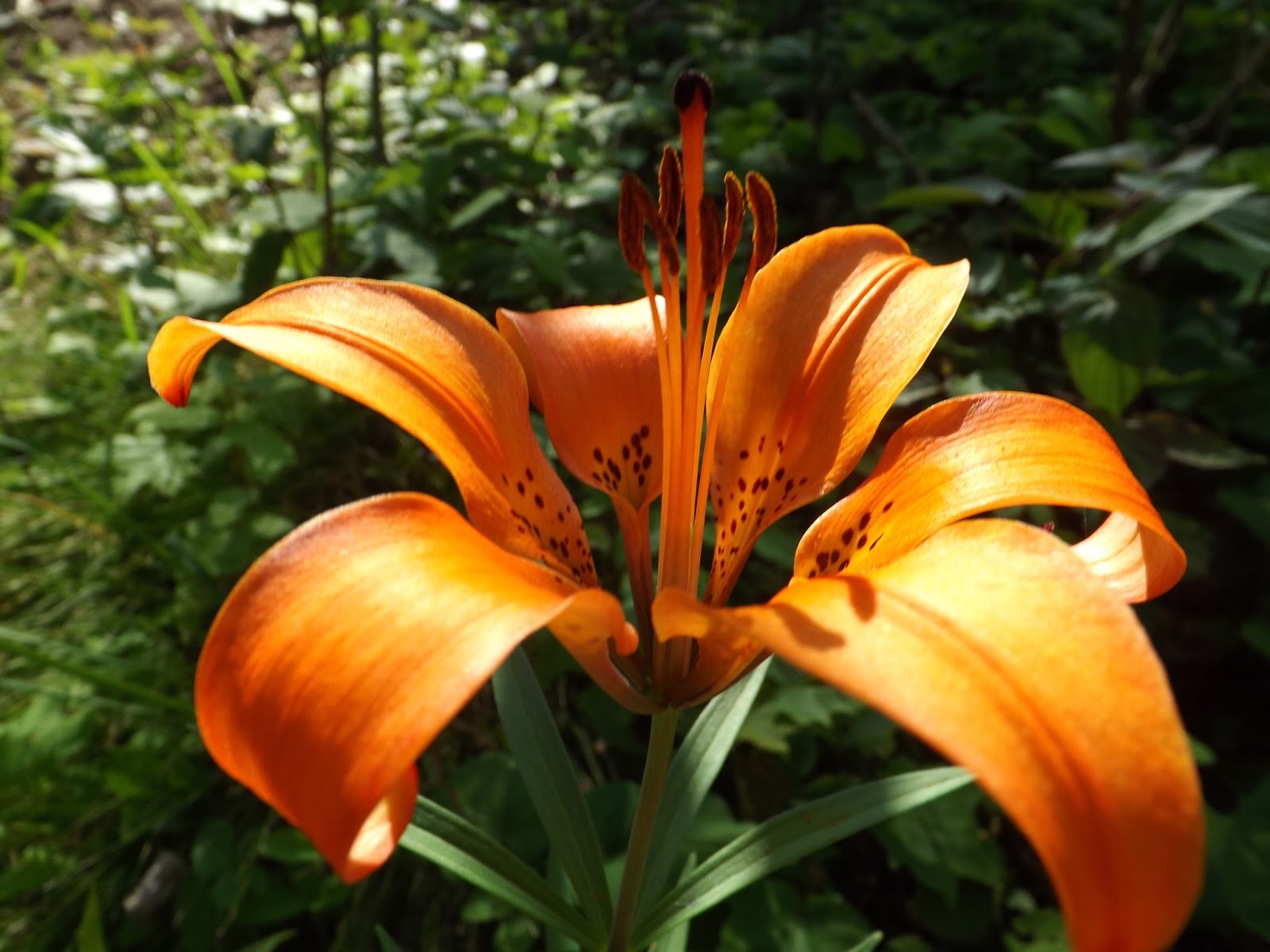
I consider this to be my 'specimen photo'. The anatomy of lilium philadelphicum is quite apparent here. I particularly love the richness of the gradation of colour from bright yellow to deep red. It is a spectacular wildflower. This specimen was growing in loamy soil at the edge of a clearing, in the shade of a stand of cedars. It gets the late afternoon sun (4hrs or so) in its location but the other specimens in the area appeared to be growing in the somewhat more shaded areas (less than 2hrs direct sunlight, but plenty of indirect or dappled sunlight).


L. philadelphicum blossom
The growth pattern of the plant (in threes and sixes) is particularly visible here. The six stamens, lined up with the six petals, and then the tripartite shape of the stigma (upper portion of the pistil, for trapping pollen), is particularly evident in this shot. I love how the points of the stigma are lined up with the three more deeply curled petals. You can also see, from this angle, the tubular section near the base of the petals (quite different, for example, from a day lily, which is of course closed at the base). The clear shadow cast by pistil and stamens is fun.

L. philadelphicum pistil and stamens
And here we take a closer look at the pistil and stamens. I particularly love the way the pollen accumulated on the lens of the camera, resulting in that dappled, sparkly look. The anthers (pollen-producing parts at the tops of the six stamen) look rather like grains of wild rice to me, and the filaments (stalks on which the anthers are located) are beautifully coloured. You can see that the stigma's tripartite appearance from the top is the result of the intersection of three bulbous portions; the curved lower edges are visible from this angle.